

I arrived back in Moscow on February 10, 2013. These transitional moments of leaving people and places behind which I’ll likely never see again, doesn’t get easy. I made good friends in Stockholm, so it was like saying farewell to family. It’s one reminder that no matter how beautiful or profound the experience, I’m still alone. I also had the flu.
‘You should stay in bed until you are better,’ Marina said.
‘I’m ok,’ I said, coughing and spluttering.
‘I am your host, so I am responsible for you and your health while you are in Russia. You should not leave Moscow until you are well.’
Marina’s concern surprised me, not because it was out of character, but that somehow I fail to get accustomed to the goodness of people in all this randomness. Once I recovered, we were required to visit the Federal Migration Service to rubber stamp my documents. Finally, I was feeling anticipation for my third stint in Russia.


Train to Perm
I took my upper bunk in the quad cabin and crammed my gear into the baggage compartment at my feet. Four men were seated on the two lower bunks and were pouring shots of vodka as the train departed Moscow for its trans-Siberian journey, which would not terminate until reaching Vladivostok, seven timezones away. The carriage became a neighbourhood full of boisterous residence moving along the aisle, visiting their neighbours. I wondered how everyone seemed to know everyone, or was this just the Russian way? Beneath me, glasses clinked and emptied. One of the men slit open a pack of cured salmon to the delight of his companions.
‘Kamchatka fish!’ he announced, passing me a chunk of the oily flesh with filthy fingers. His pride in the quality of the fish from the Far East, was fully justified.
I stretched out on my bunk and settled down for 19 hours of warm comfort as the train rattled across the sparse, frozen land. Tuning in to the melodic rattle over tracks, the wobble of the carriage, the panning light and shadow in the passing night, I couldn’t help but be excited by the thought that every frigid, kilometre passed, was yet to be cycled. I felt a true connection to where I had been and where I was going, back deep into the Russian interior to resume my travels through new places, populated with new characters.
My cabin comrades were on a bender. One eventually passed out into deep, guttural snoring. The salmon guy had more partying to do, however, and disappeared for a while, then crashed back into the cabin blind drunk and prodded me awake for chatting.
‘Please, no, I’m sleeping,’ I mumbled.
With or without my poor company, he wouldn’t be discouraged and kept talking to himself until he too slumped unconscious over the cabin table, joining the snorting chorus.
Both men departed before dawn, leaving me with a guy in his 20s. From his waking moment he was back on the grog, progressing through warm cans of beer in the new day like the party was just getting started. He was somewhat irritated that I had turned down his progressively slurred invitations to drink, so I did the gracious thing and accepted a beer, but that only made me feel nauseous. He disappeared for an hour or two at a time, returning evermore drunk and confrontational. I can’t say it put me at ease, not least because his 10” hunting knife he used to cut cake, rattled on the table, and glinted to me every time I rolled over.
The train pulled up at Perm station and I followed the few passengers climbing down from the carriage into the cold dark, where Julia and Sergey greeted me. They had moved into a new apartment building in the western outskirts of perm, where they lived with Sergey’s elderly father, Lada the Labrador, and one disgruntled cat that showed its disapproval of the move by leaving puddles of pee around the home. With my cough persisting, Julia also had concern for my health and insisted that I recover from the flu before embarking on the next winter journey, so my midweek departure was postponed until the end of the week.




Back on the Road
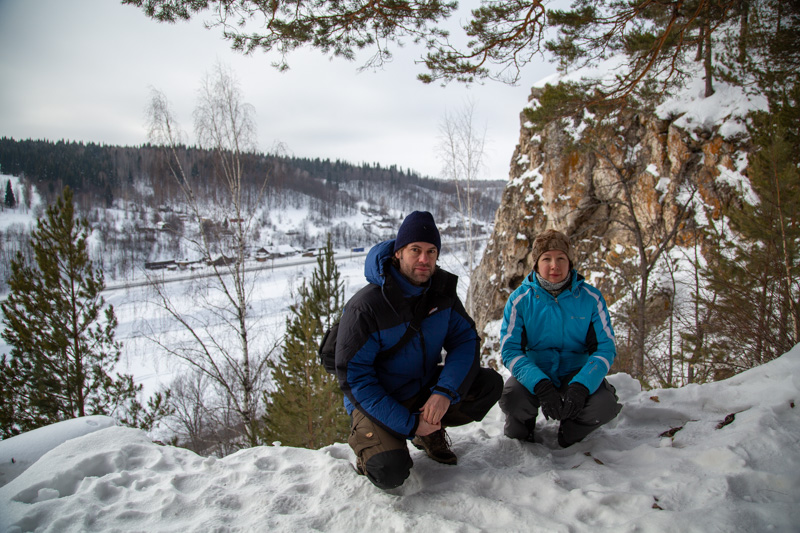
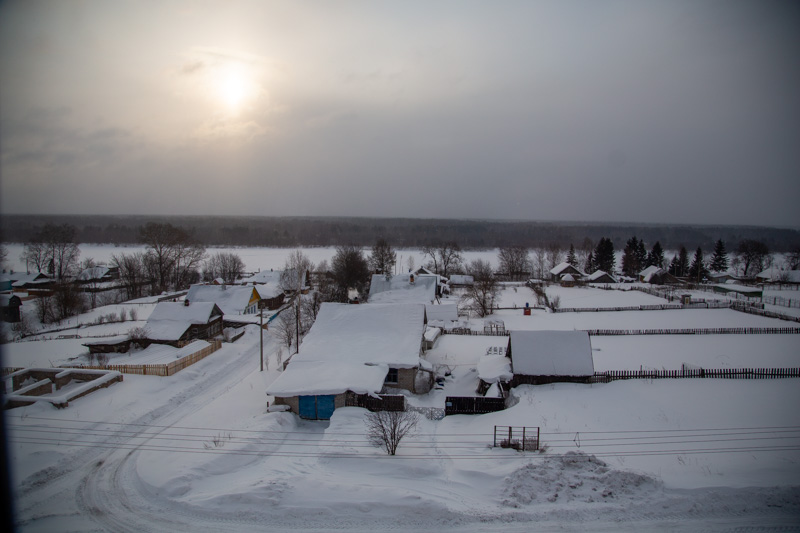
I headed out into my second winter in Russia with more confidence than the first. It was still a serious undertaking but I had decoded much of the mystery of extreme cold survival. It was no longer theory, but something familiar. I knew the stages of loss of feeling in the extremities. I was proficient in managing perspiration. The systems and routines that I had employed in the Russian Far East had proven effective and allowed me to outlast the winter with all parts intact, although my toes and fingers were still numb a year on.
A kilometre down the road from Julia’s place, I asked a man for directions. I was fattened, and soft, and barely underway, but life was about to get uncomfortable. With a gesture of compassion, or perhaps pity, the man opened his wallet and passed me a 500 Rouble note, as if to say, Godspeed … Stay alive! I tried to refuse his donation, but he wouldn’t have it, and so my encroaching superstition saw the note packed away with my passport, never to be spent.
De-icing salts turned the road to slush and trucks showered me in it as they sped by. Arriving at a town, I took a break at the war memorial and warmed my hands by the eternal flame, while I devoured the sweet bread Julia had packed for me. I hoped my loitering at the memorial wasn’t something to cause offence, although I took the time to contemplate the long list of names engraved into the perimeter wall. This town, like most, had sacrificed dearly to the Great Patriotic War (WW2). It’s impossible to imagine the bloody inferno these men endured and perished in.
A young couple dressed in tattered clothes walked up the memorial steps to greet me. I wondered if they were squatters, they certainly had very little and yet this young man, seeing me crouched at the flame warming my hands, removed his gloves and offered them to me. It was an act of extraordinary compassion. Of course, I had multiple pairs of gloves and mittens for my various daily tasks, and could never in good conscience take those of another man.
Rolling through the Taiga (subarctic coniferous forest), I soon fell back into day-to-day simplicity of life on the road—small challenges that kept me in the moment and irrelevant concerns at bay. As the day faded, I looked for a break in the forest to pitch camp. In an attempt to cut weight, I left my snowshoes in Sweden, and now looking at the meter and a half depth of snow ahead of me, I realised I had made a big mistake. The previous winter, the snow shoes allowed me to easily cut a track through the forest no matter how deep the snow. Now I had to stamp down the trenches to my camp site with my boots one step at a time, sporadically post-holing waist high into the snow.


Broken Stove (again)
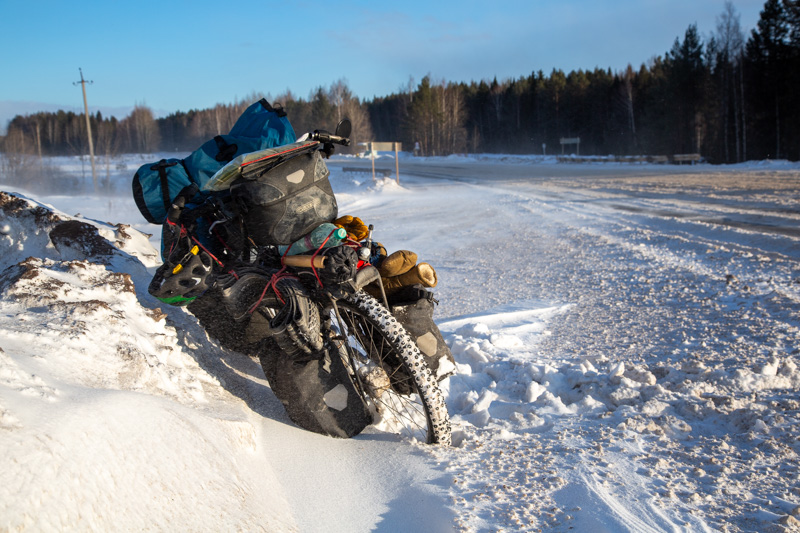
The road wound gently through the forest. One afternoon, a fresh layer of snow covered the ice road, which was the one condition that made the road slippery by preventing spiked tyres getting purchase on the ice. A dip in the ice took out my front wheel and I crashed hard. I heaved my bike back on two wheels, and then I heard the hissing. I knew that sounds like a recurring nightmare. I checked my stove, now attached to the top of the front rack to protect it from this exact danger. The fuel line had snapped off the fuel bottle, and fuel was spewing out as it depressurised. No … Not again! In the deep freeze, plastic snaps like chalk. It has no place on equipment as crucial as an expedition stove. And this infuriating design flaw had now failed me a second winter in a row.
A short while down the road, I came to a roadhouse. I had to get away from the bike, accept that I would spend another winter stoveless. Inside the building, steamed meat and sodden timber permeated the air. A life-size wooden statue of a bear stood upright, defensive, watching over half a dozen truck drivers mopping up their stew and potatoes. I ordered a dish of ris i myaso (rice and meat).
I rested against my layers of installation draped over the chair, feeling the sting of blood running back to my cheeks. I looked over my map, but it didn’t tell me anything much except how far I’d come since Perm. Organic shaped swaths of forest marked the road ahead. Route options were limited with few cleared ‘winter’ roads, but where paths diverge I tendered to take the northern route into the Taiga.
I put the map away and watched the characters in the room. I was living that dream as a kid studying those old National Geographic magazines full of evocative photos of people from the remote corners of the world. The truckies at the table in front were making fun of me with my stupid map and ludicrous bicycle. This was perfectly understandable.
‘There are many bears in this area,’ one man said, pointing to the wooden statue behind me. The men laughed.
‘Er … How many?’
‘Wolves too! And it’s very cold,’ he added.
This was Igor, a solid, Central Asian guy in his 40s, with a furrowed brow and dirt stained skin.
‘What are you doing? Where are you going? Where are you staying?’ Igor asked.
Amused by our unlikely encounter, he encouraged me to stay the night, though after my feed I’d be moving on. But he was adamant that I stay, and before I knew what was happening, he had collected a round of change from his comrades and paid the waitress my lodging for the night.
‘Get your bags, come.’
I followed him up the creaking timber stairs to his room, where there were three empty beds. The roadhouses were generally small and cheap with communal rooms and shared facilities.
‘Why are you staying here, Igor?’ I asked, as I pulled out my booties and unrolled my sleeping bag to dry.
‘My truck is broken so I am here until it is fixed.’
‘How long will that be?’
‘I don’t know. A few days. I’m waiting for another truck.’
I felt kinship with the truck drivers, even envy in an idealistic kind of way—making long journeys to the Far East, or to Kazakhstan, or wherever, and sharing camaraderie with men of the road and sisters of the roadhouse. I saw the positive side, but it was all I could know. You think about the distances that Igor was driving, delivering one load of goods, in one old Kamaz, to one impoverished country. His truck broken down and the roadhouse home until the parts could be delivered and the repair made. You think about the weeks away from the family. I had been in many of these places across Russia, seen the same faces over and over, often tired and alone, eating their meals in silence. It was the other side of those thunderous trucks which would drive me to distraction, but the faces were those of good people living tough lives.
The morning was calm, sunny, -30°C. I bought some biscuits and cakes at the cafe and a guy who I hadn’t spoken with before, pointed to my supplies and shook his head. ‘Eat meat,’ he demanded. He got me to take a seat for a huge breakfast he had apparently ordered, and the food came out in courses: bread, milk, eggs, dumplings, hotpot of meat and vegetables. While I was packing my bike, he returned and gave me a bag of frozen chunks of pork and beef.

Fire
After a good day in the saddle rolling through the beautiful Taiga, I pulled over in the late afternoon, cut my trench to camp and lugged in my gear. The loss of my stove was a bugger, but it didn’t detract from the joy of being out in the wilderness. In a way, it made the challenge more rewarding because it allowed me to hone my skills, and so I got on with the duty of producing food and water by fire.
Ideally, you would use a snow shovel to dig down to the earth and then you could build a bonfire if you like, but the snow was deep and I didn’t have a shovel. The light was gone as I dug around in the snow for logs to make a platform on which to build a fire. The fire had to burn efficiently enough to boil two consecutive pots of water (one for drinking and one for cooking), and it also needed to be stable enough to support the pot before burning through, otherwise I’d need to build another support and relocate the fire before the support collapsed, but in the deep freeze this was almost impossible without destroying the fire. (Needless to say, it takes a lot more energy to boil water from snow. The Most efficient way to do it is to melt a small amount of snow first then slowly add snow to the water.)
Good logs weren’t always easy to find, and the best I could manage this day were a few insubstantial branches. It was an exercise in efficiency because keeping a fire going in extreme cold is very difficult. Everything had to be ready to go before striking the match, so I had all the fuel, from tinder up, laid out in piles. Julia had thoughtfully given me a pack of emergency matches, but in the cold I was having trouble keeping them going long enough to ignite the tinder. I discovered that tuffs of moss growing on the spruce made great fire-starter, and I began harvesting it for my fires.
On this day, just as the lid of my pot began to rattle with puffs of steam, one side of fire platform collapsed, dumping my fresh pot of water in the snow. Arrrr! I had to build the fire three times before achieving a steaming pot of watery stew. Fire making was time-consuming, but when it was done, my belly stuffed, I couldn’t have been more satisfied.
The radiating warmth was the one advantage the fire had over the stove, but this was offset by the prolonged cold exposure. As my front absorbed the warmth from the fire, my back froze, chilling me to the core before I could take my first sip from the pot. This was going to be a long winter.
Breaking camp was a daily dose of punishment—it was the coldest and toughest part of the day. The colder it got, the longer it took, and the temperature was only going south, as I marked the lows each day on my map: -31°C, -37°C, -45°C. My cracked, frost-nipped fingers stung in agony, turning the simple act of breaking camp into a wincing, foot-stamping ritual. But pain was good; pain was flowing blood.
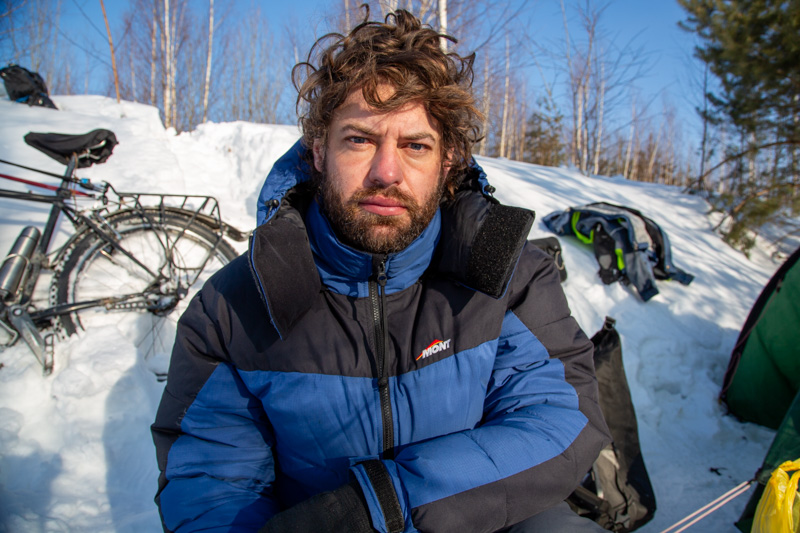
Physical discomfort is inevitable, essential even, the toll paid for the beautiful freedom of exploration and living in the moment. I describe it because it was present, but it was never something that caused mental stress or depression or the feeling not wanting to be there. Rather, it had purpose. If I don’t challenge myself for periods of time, I suffer, so for my own sanity, I need to be tested and I need to do difficult things. I think a lot of us are like that.


Kostya
Some mornings I didn’t light a fire which meant low-grade fueling with frozen, stone-hard cupcakes or sweet biscuits for breakfast. Sometimes I lit a fire midday to appease the appetite—glorious chunks of fatty meat boiled up with a stock cube, or powder soup, or powdered potato.
One morning I took the easy option to find somewhere down the road to fill my bottles with hot water. I came to a woodyard and parked my bike by the gates. A stout, middle-aged man appeared from the site office. His eyes narrowed as soon as I asked for ‘voda’ (water), giving me the sense that I might be better served bothering someone else. Still, he invited me in, allowing me to fill my bottles.
‘I am Stas, the manager here. Please sit. Would you like tea?’ he asked.
‘Thank you. Yes. Excuse me Stas. Do you have internet … Wi-Fi?’ I asked.
I hadn’t been online since leaving Perm, where I’d joined Couchsurfing for the first time, and posted a request for accommodation in Kirov. I was a day away and wanted to check if anyone had replied. But there was no internet.
After a short break, I was about to leave when one of the guys invited me inside the workers cabin by the office. Going indoors from living outside was hot, sweaty business. At the entrance, I removed my jacket and left it with the rest of the dirty outerwear hanging above a collection of muddy boots. I took a chair while my host made a cup of coffee. Two more guys arrived, and the men got excited about the journey, but beyond my magic letter (on the back side of my map case) which addressed the basic questions, it was difficult to go into details. After a few minutes, Stas entered the cabin. ‘Come,’ he said. Apparently he had organised Wi-Fi for me, and told me to get in the car. My bike could stay.
I grabbed the pannier with my computer and jumped in the passenger seat. The car turned west towards Kirov, and my gut tightened as Stas put pedal to the metal, and the speedometer past 60 mph, bouncing over rippled ice. Stas was perfectly relaxed though, no emergency, it was just the way he drove. And where was he taking me? Didn’t matter. The way ahead was mysterious and bound to be lively. On my choose-your-own-adventure, I seldom said no.


We arrived at a small village and entered the gates of a large property with a huge log cabin. I stepped out of the car, looking up in awe at this palace—more like a mansion than a cabin. I thanked Stas for the invitation, but it wasn’t his. A guy with an injured leg, came to the door.
‘I am Koster, like the boxer, Kostya Tszyu. You know?’ he said, with a smile. (Russian-Australian boxer)
After a feed of cured meats, cheese, and soup, Kostya showed me around the place. It was like no other home I had visited in Russia. A four-story log mansion, a palace of sorts among the village dachas. In the basement, he showed me his snowmobile—the culprit of his injury.


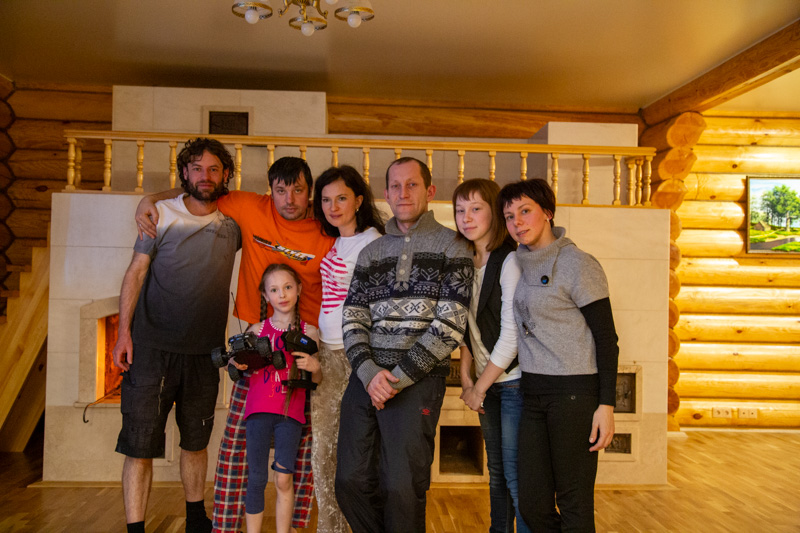
‘This place is beautiful!’ I said.
‘You will stay here tonight. Your bike will come in the car,’ Kostya said, slapping me on the shoulder.
The day turned into evening as more people showed up, and a banquet of meat, rice, and vegetable dishes covered the table. It was Women’s Day. I Remembered the last one. Christ! One year since De-Kastri and that public holiday when the bank was closed, leaving me penniless for a week in the Far East.
‘This is Bulgarian wine from my friend’s vineyard. It has no label but it’s very good quality, yes? … You can call your family. You can use my phone. Anything you need just ask,’ Kostya said.
‘Well, there is one thing. I broke my stove. The fuel-line is broken, but I think I can fix it with epoxy. Do you have any epoxy I could use.’
Russians are resourceful people—they have to be—and just showing Kostya the stove guaranteed that it would be fixed if it could. One of the guys took it away, and a few hours later returned with the fuel line attached solid with a thick coating of epoxy. Though it would leak slightly, and the nut no longer revolved, I had a functioning stove again. I couldn’t have been more grateful.
‘What do you do Kostya?’
‘I build these cabins. It’s my company.’
‘Well, it’s great. I would love to have a place like this,’ I said.
‘It is almost finished. It took seven years to build this. One day I will come to Australia and help you build one.’
In the late hours, wine-sodden, I stumbled up the stairs to my top-level room. In the new day I woke hung over, but then I looked through the window across the frozen river, thinking just how beautiful life can be sometimes.
That morning, Kostya dropped me back to the woodyard so I could pick up my route, and cycle the final 40 km to Kirov. An hour later I was back in the centre of the village, where a policeman stopped me for to my papers. As he was scrutinising my activities, Koster arrived in his black Audi. The policeman was shocked that we were friends, and promptly let me be. Kostya was obviously a man held in high esteem. Unbeknown to me, after dropping me off at the woodyard, Kostya had sped to Kirov to collect a city map and a spare tube of steel epoxy. ‘Good luck my friend,’ he said, handing me the gift.

Kirov
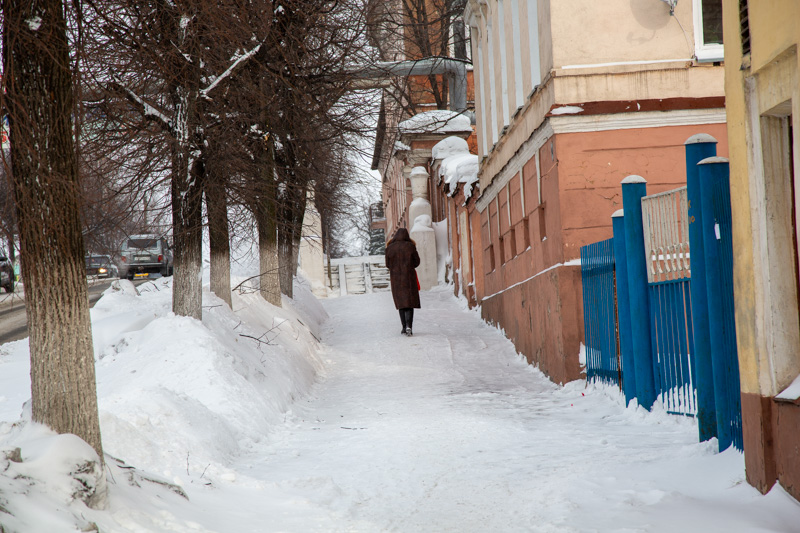
Galina, the Couchsurfing host in Kirov who I’d contacted from Perm, had graciously accepted my request. I discovered that during the two weeks I’d been off-line since, Galina had sent me several emails inquiring about my whereabouts. ‘I lost my guest. Hi Benji! Are you okay? I’m waiting for you. Galina.’ I let her know that I was fine and would be arriving in Kirov the next day.
I had also been contacted by a member of the Kirov Cycling Club who had seen my request, and he too kindly offered the support of club members during my stay in the city. A few kilometres from Kirov, I crossed paths with the group of cyclists. They had come to escort me into town via a scenic route, stopping in the old quarter for a meal at a stolovaya. I’d found a brotherhood of cyclists, no explanation required as we chatted about cycling. One of the guys summed it up simply, ‘I started cycling one year ago, and it changed my life.’


It was dusk by the time I arrived at Galina’s apartment block. My new friends help me lugged my bike and gear up to the fourth level apartment. I was ashamed at how filthy I was, and wondered how Galina might feel about having my muddy bicycle in her small and immaculate apartment, but she didn’t seem bothered at all.
‘We have been waiting for you. I’m very happy to see you,’ Galina said. And as is so common with Russian hospitality, Galina treated me as a surrogate family member for the short time I stayed with her.
On the second night, the cycling club had a party. It was encouraging being with people who celebrated winter cycling. A group of them were planning a winter traverse of the frozen Lake Baikal, so I offered some tips on winter camping and hoped that some of my strategies may help them with life in the cold.


My final task before departing Kirov, was to replace my worn bottom bracket and running gear. It had done 12,000 km from Sakhalin to Kirov, and the bottom bracket had corroded onto the frame, so it took the help of my new friends to wrench it loose. I’d been carrying the replacement parts since China, so it was good to offload that deadweight from my panniers.

It had been an intense few days, from Kostya’s to my friends in Kirov, everyone had treated me so well. My humble journey had a tendency to touch people in some small way, and I was accruing a debt of gratitude that I couldn’t possibly pay back.
‘Some people have dreams to own a car or a house, but your dream is only to cycle around the world,’ Pavel said. ‘I will think about you … Where is Benji? I wish you nyet problem!’
To be continued …


 Earth Odyssey Expedition
Leave a reply to Justine Beatty Cancel reply