
Greetings from Norway!
I wrote most of this blog a year ago but I’ve only got around to completing it now. It describes the second part of my journey through Mongolia up to the Russian border. For the first part go to: Mongolia Part 1: The Gobi Desert to Ulaanbaatar. The next story will describe my journey through central and western Russia.
This hasn’t been an easy one to write, and I post it with some reluctance because, frankly, honesty is a bitch. After all this time I still can’t get enthused about publishing my life on the www, but since I’m at it I will endeavour to describe this experience openly. This is a long (hopefully not too boring) read, so I’ve loaded it up with photos for encouragement. Happy travels dear readers!

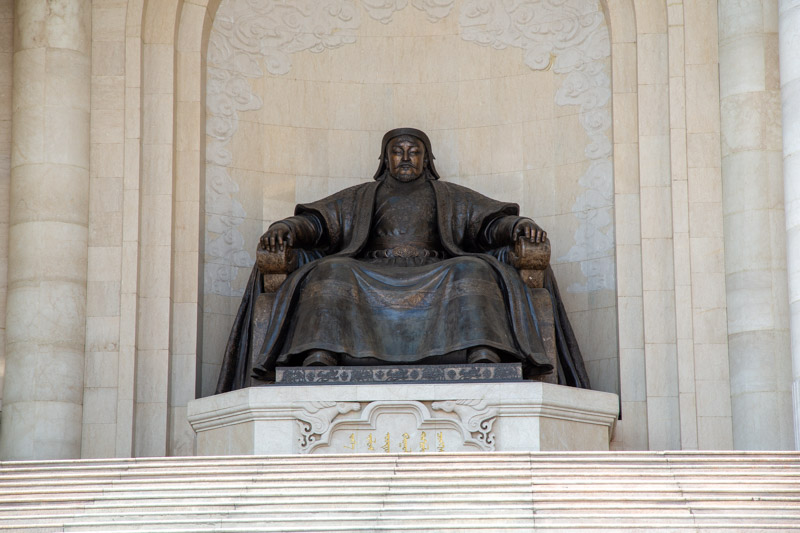
Genghis admiring his empire, flanked with a pair of his warriors.

ULAANBAATAR
Ulaanbaatar is loud and grotty. In June 2012 the city is stinking hot when it’s not being battered by torrential rain every other day. Mongolia’s capital, isolated by the arid sands of the Gobi to the south and the verdant steppe stretching across the north, seethes with activity, with drunks stumbling through streets, and drivers that care little about life or death. History tells the story that these people are part of something unique. With pride just about everything is named ‘Genghis’ something or other. Foreigners outfitted in the latest adventure mode scatter along the tourist trails, and hawkers bounce among them like pinballs, flogging mass-produced paintings of the steppe and her nomadic people.
In the Grand Kahn (Ulaanbaatar’s authentically named Irish pub) I meet up with European TV producers, Pia and Ansje, to talk about filmmaking and adventure stories. We’re among an establishment of wealthy expats—engineers, geologists, and pudgy tobacco-puffing businessmen with loose ties and sweat-stained shirts—talking over heads about investments, and ventures, and cutting up land into pieces of pie. Their story is the burgeoning mining boom.
‘So what’s your story? Why is it different?’ Ansje asks.
I cringe at that question, but she’s right, the media requires an answer if I ever plan to turn this into something.
‘Probably nothing,’ I say. But that is unsatisfactory. I think some more. ‘It’s long, more than a decade alone. Most people can’t get their heads around that kind of commitment in a solitary endeavour.’ I’ve been on this road long enough to know that there’s really only one set of questions and one set of fears that people try to resolve. But Ansje is unconvinced about the value of this.
‘By the time you get back to Australia people would’ve done more extreme things,’ She says.
I don’t know what to say. If I’ve ever thought about it this way, I don’t anymore. I didn’t know what the story was when I began and I still don’t. I just can’t see my journey from a marketing perspective. Not while I’m in the thick of it. Not while I’m trying to get the job done.
I had hardly spoken English for seven months so it was odd meeting foreigners in Ulaanbaatar, trading stories with adventurers, independent filmmakers, expats, and so on. I met a Frenchman who had financed a 10-year travel escapade by gem smuggling and gun running, and an Italian guy who had been sitting around in Ulaanbaatar for 6 months trying to get a residence permit so he could go get a flock of sheep and live on the steppe.
‘I wan’t to be a nomad,’ he told me. I didn’t need to ask why. I’m sure he would find enough people to ask that question.
Due to leave after 11 days in the city waiting for my visa extension, I met a Greek guy ‘travelling around the world in 40 days’ (he didn’t have time for the 80-day thing so he halved it), and we hung out most of the afternoon. It was a public holiday, which for whatever reason prohibited the sale and consumption of alcohol, but fortunately a storekeeper accommodated with disposable Coca-Cola cups so we could have a beer in the street. He would be one of the last travellers I would met until reaching Europe.

PUSHING WEST
I departed Ulaanbaatar in the late afternoon and cycled well into the darkness through 30 km of heavy traffic—at one point straying off the thoroughfare and losing myself for an hour in the dusty sprawl at the west end of the city. An aggressive driver pounded his horn and drove me off the road with bleeding ears for no apparent reason. Evidently, this was not the kind of place to hang around in. Back on course, the concrete road deteriorated into 10 km of mud, gravel, and patches of road works, before diminishing into the verdant steppe.
I had stupidly forgotten to withdraw cash in UB so I only had about 5000 tugrik ($3) with me. It was a bad oversight as I wouldn’t get to a bank for 8 days. With my fuel gone and most of my rice, my only food supplies were a pack of powdered milk substitute from Korea (nasty stuff made of palm oil), a pack of stock cubes, and 5 kg of dried cranberries, sultanas, walnuts and almonds, which I had bought anticipating food shortages in the country. Crammed into my panniers, the 5 kg of fruits and nuts seemed excessive, but now I was glad to have it.

I met Ben and Matt from San Francisco at the end of their Mongolian ride. They gave me a bungie strap, tube, Marathon XR tire, and a 4 l water bag. Thanks guys!

I sweated through the heat and wind, and sucked on bitty pieces of stock cube to relieve my salt deficiency. Several days of chilling rain followed several days heatwave as I travelled west on one of the few sections of sealed road in the entire country, until it expired into a directionless web of mud tracks.
The road was marked incorrectly on my map, which placed it 20 km to the south of my position, so I picked the most southward track from the lottery and took a bearing towards a rocky precipice, where a herd of goats and sheep stood motionless and miserable in the drizzle. I felt no better, waterlogged through my worn and failing Gore-Tex jacket. I had no way of knowing where the track would lead, but with a serious aversion to backtracking, I travelled it for about 35 km through mud, sand, and clay, until arriving at the tiny village of Ogiynuur—a cluster of timber shacks woven together by mud tracks and plank fences. There I got a mouldy loaf of bread and hot water, to which I added a stock-cube and called it soup. When you’re ravenous you don’t give much thought to what goes in your mouth.
The downpour persisted through the next day. Lakes formed in the depressions of the terrain, and the tracks, streaking the boggy ground like matted hair, expanded to the size of football fields. I continued along the mud track that should have taken me to the village of Muhartsagaan and on to the road 32 km beyond that, but without a functioning odometer to measure my distance and accurate topographical maps to decipher the terrain, it was impossible to know where I was or which of the countless dirt tracks hatched across the landscape by vehicles not adhering to any official route, was the one marked on the map.
I followed the splintering track south-west as best I could until it petered out onto a hilltop at a vacant stock pen. I stood on the crest, surveying the featureless ocean of grass rolling out in all directions, trying to make out some correlation between the hills to the south and the rough contours on my map, but it was no good, so I slopped through the pungent sludge of manure and blood and hunkered down under the dripping shelter to eat through my rotting loaf of bread. About 500 m back, I found fresh tyre tracks that were running east-west and took the east route for several hours until I came to a ger. I was 12 km from Hotont, 36 km south-east of my target.
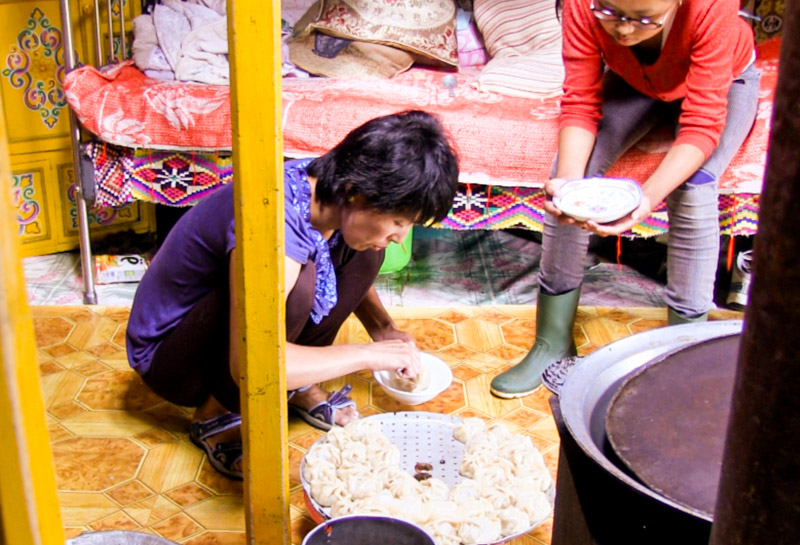
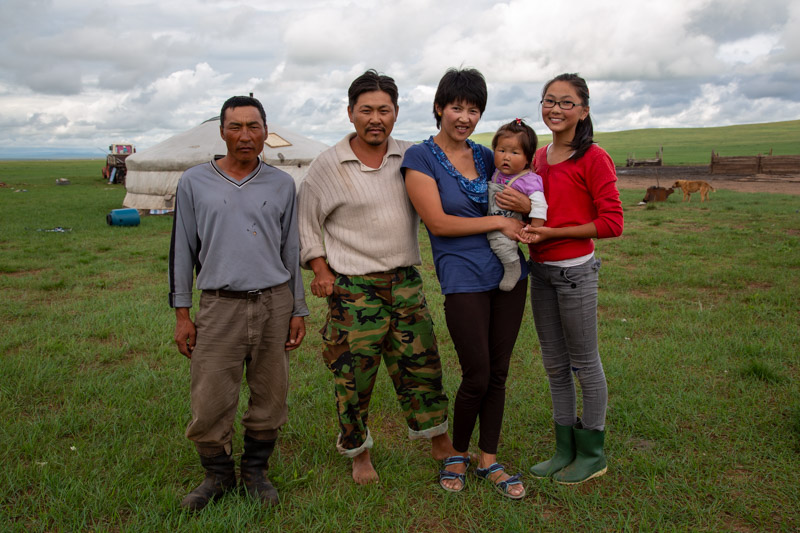
As a visitor I was obliged to enter the ger. It’s a unique aspect of nomadic culture. Gers are not only homes but effectively serve as way stations, which allows nomads to travel long distances quickly. The men were outside servicing a rifle. Inside the ger the women occupied themselves washing clothes and attending an infant. I warmed myself by the fire with servings of fermented milk tea and aaruul (rock hard milk curd). One of the women spoke a little English.
‘I live in Ulaanbaatar,’ She said. ‘I am visiting my sister for the holidays.’
She took a ball of dough and began kneading.
‘Can you eat Mongolian food?’
‘Sure, I love Mongolian food.’
Of course, I still wasn’t exactly sure what Mongolian food was. The last thing that was offered to me in a ger was so repugnant it made me recoil. But in this moment I was hungry enough to know that I likely wouldn’t have much problem eating a fallen comrade should a situation get desperate enough.
I could feel the skin over my ribs tightening, my stomach collapsing, screaming for hot, fatty food (anything that didn’t consist of sweet, dried fruit and nuts), so I was delighted to see the dough rolled and pinched into buuz (mutton dumplings), laid onto a large, aluminium steam tray, and placed over a boiling cauldron of water. The family joined in a circle around the fire and we filled our bellies with dumplings and milk tea. Energised by the warmth of the fire and the goodness of these people, I bid farewell and pushed off over the mountain saddle and descended the valley to Hotont.
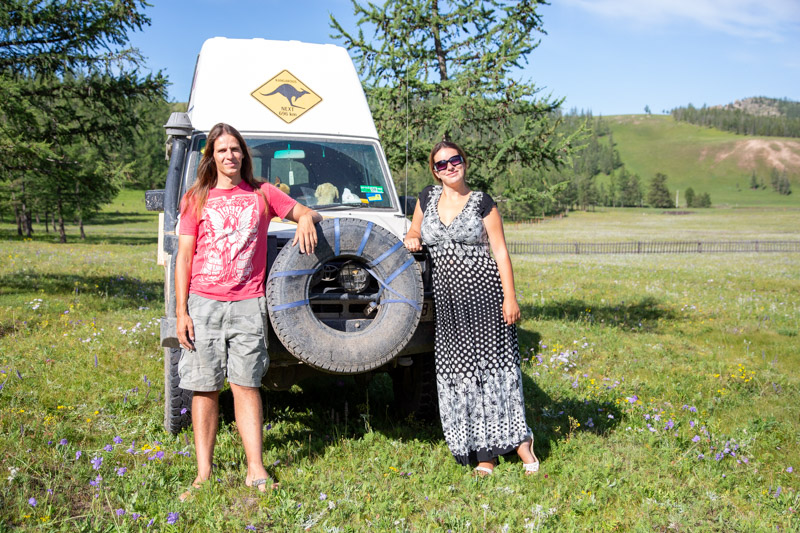
At Tsetserleg I bumped into Konny and Andi, my German friends I met in Eranhot, at the Chinese-Mongolian border. They were driving back to Germany from Australia.
Since I couldn’t trust my maps I tried to fix my odometer—which was my only navigational aid other than my compass—by reattaching the torn wires to the contact plate with superglue. That predictably failed, so I sought a soldering iron from a village mechanic. While his wife served me tea and snacks, he set to work, fishing out an electric soldering iron from his collection of rusty tools, but without electricity, resorted to using a propane blowtorch to heat the iron and attempt to reattach the wires with scrapings of residue solder. The crude fix melted through the back of the device. The mechanic was disappointed it had failed and refused to take payment for his time, but at least his concern helped to counter the annoyance I felt for the vandals in Ulaanbaatar that broke it. Now it really was irreparable and I would have to find my way to the Russian gates by compass alone.
ISOLATION
Thunderstorms were bursting in cycles and delivering torrents of rain every day or two. Sunny mornings made me sluggish around camp, cooking, drying gear, and solar powering my cameras, but the weather could flip quickly. One of those mornings I took cover from the storm under a bridge. Shortly after, two men and a boy arrived on a motorbike to share the shelter. I already knew them because they had visited my camp earlier and were the only souls visible in that vast landscape. The senior guy had been on a mission for Vodka but I had none to give, however, he must have scored somewhere as he was now intoxicated and had a deep, bleeding gash over his left eye. He stumbled my way snarling like a dog, hair raised. I stepped back having no idea what he was saying, but clearly it wasn’t the kind of dialogue that promotes healthy relations between strangers. I tried to ignore him, gazing out of the tunnel through the opaque sheets of rain driving down from the east, but listening to this guy spewing bile like a cooked battery, made me clench. I would absorb his words but I wasn’t going to hesitate to defend myself. Though before things got messy, the kid, who appeared to be around ten, dragged the man away by the cuff of his deel to the opposite side, where he stumbled and crashed to the ground, and was free to mouth off from a distance.
I had gotten to that point where I needed the solitude—though it seems like a contradiction while journeying through the country with the lowest population density. The fact is that I had become so deprived of conversation, so accustomed the struggle of communication, that I was growing apathetic, and the common drunks weren’t helping matters.
People fear isolation, being removed from the tribe. But they shouldn’t. Being alone is not the same as loneliness, and vulnerability can be nourishment for the soul if you allow it. It’s an effective mental detox if you can handle it, but I was learning that heavy doses of isolation has side effects and can lead to dark places. I was getting a deeper reflection, but with time my mind was losing clarity, internalising problems, getting hung up in the past and on stuff that doesn’t matter. I had been on the go for eight months without significant contact with anyone, and during that northern stretch of Mongolia I was aware that I was beginning to sink too deep within myself.
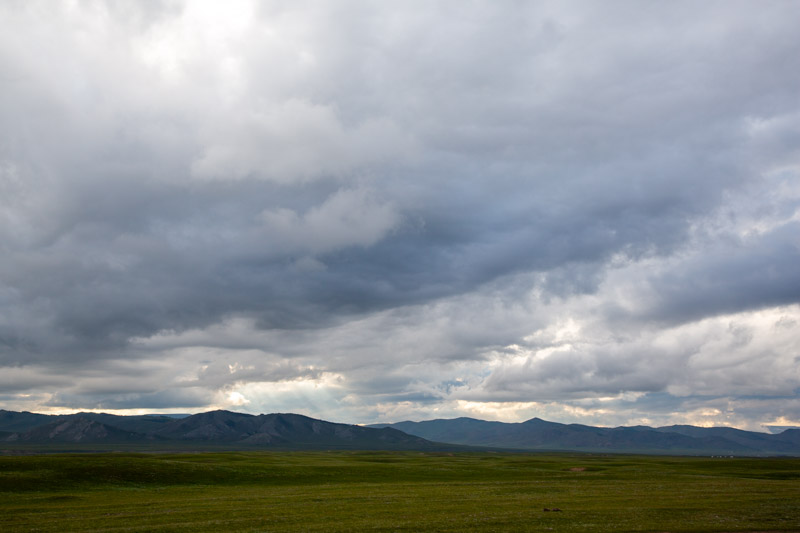


I toiled across Mongolia over every kind of dirt, gravel, sand, clay, and rock condition known to man—tracks generally so unbearable that even the jeeps avoid them. Rain deteriorated conditions further, caking everything in mud, and the prevailing headwind was so predictably west-northwesterly that I could quite reliably use it as navigational aid.
Donkey (my bike) weighed over 65 kg loaded with heavy supplies of food and water. I pushed over pass after pass and dropped into sweeping, half-dome valleys carpeted in velvet-green pasture. Knotted layers of cloud choked the skies, and sunbeams speared to earth through chinks in the canopy, illuminating the horizon in fine streaks of silver.
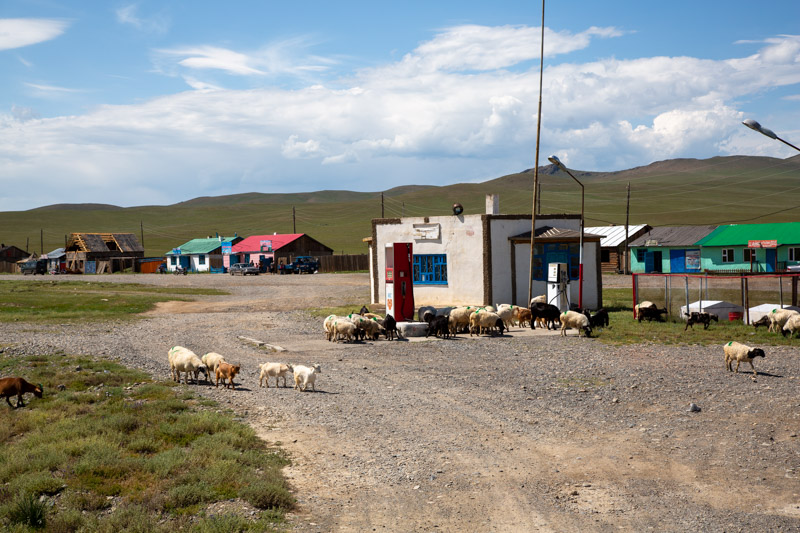
Hungry and cold, I slopped through the rain and muddy earth into the village of Tariat. I visited the handful of tiny stores, all stocking the same pitiful range of Russian tinned foods, sweets, biscuits, stocks and flavourings—no grains, dairy, eggs, fruits or vegetables. I looked for anything fresh but all I found were three bulbs of garlic, which I grabbed with excitement, but the shopkeeper shook her head; I could take only one clove, she indicated with one finger. That there didn’t seem to be any vegetable patches nor even a chicken coop in these villages, was unusual and perplexing.
One drizzly day a nomad boy of about eight invited me to his camp with great enthusiasm. I imagined him shouting something like ‘Look what I found!’ as he dragged this muddy, dripping rodent into the central ger to join the family of six around the fire. They amused themselves with my map, spreading it out and scrutinising it as though they were searching for treasure, while I sipped on cups of steaming yak-milk tea and snacked on aaruul. Both of these pungent staples are an acquired taste that I was never to acquire. I had been given a phrase book but I rarely used it. It wasn’t necessary to talk. The essence of these encounters on the steppe seemed to be in the tradition of providing shelter and sustenance to others, within a support network necessary for survival. It seemed to be ok to simply observe the scene, rather than engage in strained communication.
As I was leaving the father gestured for me to stay in the visitors ger. Though it was early in the afternoon, I couldn’t turn down the experience. He lit the rusty stove in the centre of the ger with a sparing amount of wood, paper scraps, and yak dung, filling the air with puffs of acrid smoke. I spread my gear to dry around the fire, above which, strips of curing mutton hung from cords. Outside, the silence was disrupted by the arrival of a motorbike. The father put his ear to the door and flicked his throat, which I knew to be the Russian gesture for ‘alcoholic’. He signalled for me to stay put and out of sight.


I had little time to break. I was running against the visa clock, so I set to studying my maps, estimating distances of alternate routes, trying to determine the quickest way to the border. But my focus was hindered by the boy eager to ride my bike. He was so relentless I let him ride it twice, around in circles, and cringed every time he slammed on the muddy breaks. Rim brakes destroy rims, especially on a loaded bike, and I had blown 3 already in the course of the journey. A popped rim out here would be disastrous; I would never make it to the border in time, my remaining Russian days would squander away, and I would fall into another impossible, bureaucratic mess to simply join the dots. It would be a route-changing error. My desperation to make it back into Russia, foreboded mechanical failure throughout my trans-Mongolian quest.

I hadn’t seen television for months, but out there on the steppe in a canvas dwelling, we tuned into a crackly, analogue signal to watch Cuba defeat Mongolia in a London Olympics boxing match. It was a disappointing result.
We ate together, mutton broth with handmade noodles (similar to Japanese Udon). I never saw any nomad food or beverage that wasn’t made from scratch. During the meal the irritating boy was skipping around me and chanting, ‘Dollar! Dollar!’. This annoyed his parents also, but the night would only get more bizarre. The father began making animated gestures towards one of his teenage daughters, saying something that I interpreted as: ‘She’s beautiful, isn’t she? Do you want her?’ I thought it was a twisted joke, but his lack of emotion seemed to indicate that he was trying to prostitute the girls. I withdrew myself from the subject.
In the morning while the camp was asleep, the father watched me hawk-eyed as I packed and strapped my bike. He had become noticeably less genial.
‘Mongol dollar!’ he eventually demanded, rubbing his soiled fingers.
I gave him 10,000 tugrik (about $6), and pushed on.
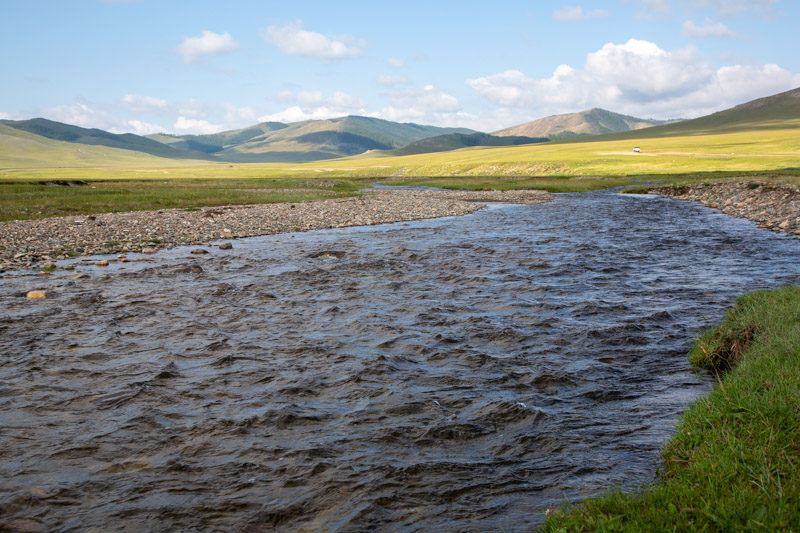
That day I had an exhausting climb and was greeted by a heavy hail storm at the summit. By late afternoon the skies opened and I was zooming down into the next picturesque valley. Ger camps spread along the river bank.
I was summoned by a group of herdsmen. They were wrestling a seriously distressed yak bound in rope, struggling to insert a nose ring made of metal cable. The procedure looked excruciating. Once the drama was over and the beast released, I was invited in for tea, milk curd, and Boortsog (a type of fried dough). We shared mutton noodles, wild blue berries, and ‘yak vodka’, which I believe is produced by fermenting and filtering the whey of yak’s milk. [Check with Dad]
At dusk I was encouraged to camp there. Though I intended to be alone that night, I was conscious of being rude if I didn’t accept. It was a decision I would regret with the stench of urine permeating through my tent that night.
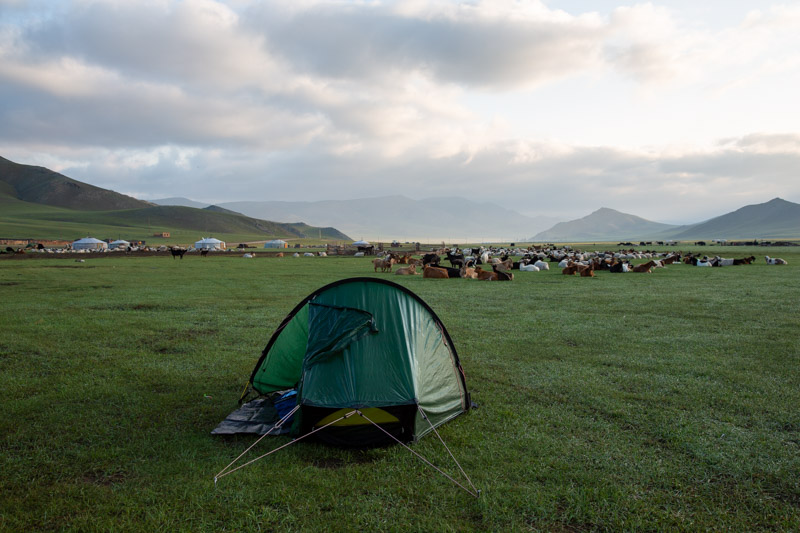
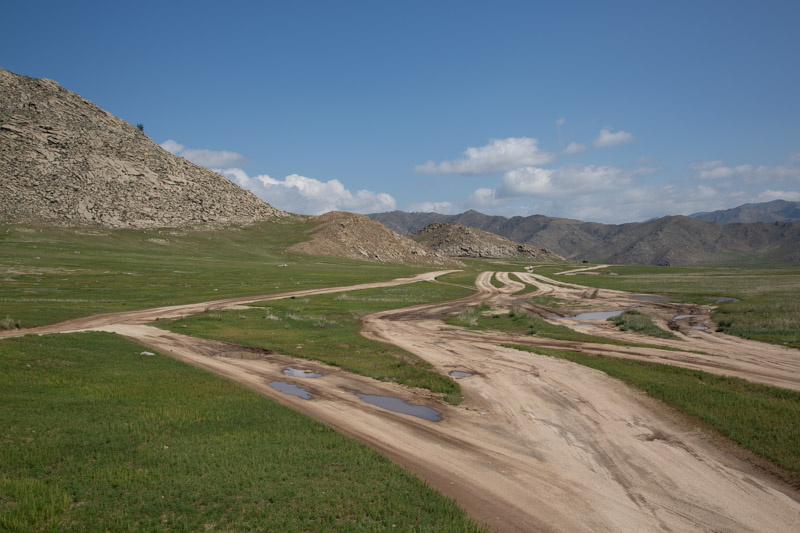

This is about as good as signage gets in Mongolia.
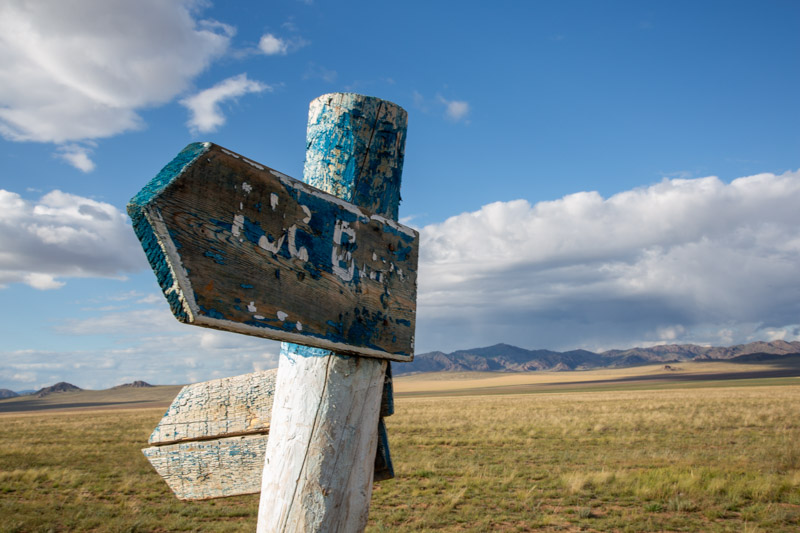
Your guess is as good as mine!
On sunny mornings I would absorb the sun, dry my gear, and charge my solar pack, which I used to charge my camera batteries.

HIGHER GROUND
I pushed myself onwards to make the kilometres against the maddening gales and bone-chilling rain. I was now travelling at an altitude of over 2000 m. Frost was depositing on the ground and seizing the zipper on my tent. I had no cold weather gear and I shivered through the nights without a sleeping bag. I had long days in my favour but I was burning out, suffering fatigue, nausea, and loss of appetite. Without fresh produce, my diet was mostly processed and nutrient deficient. The bland (no salt and spices) greasy Mongolian food, almost entirely produced from meat, flour and dairy, was now making me ill.
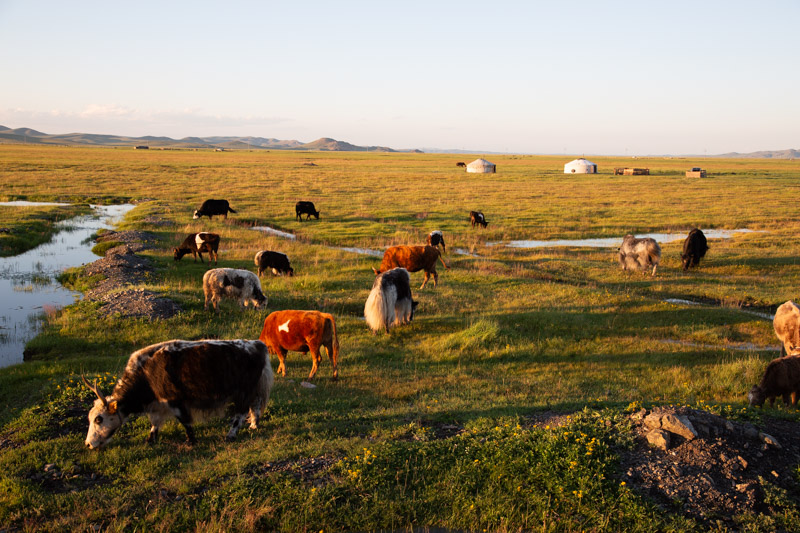
Then conditions began to improve. I had a week of clear weather and little wind. Gers were few and far between. I was still battling the sandy, rutty tracks, and losing my way, but was happier doing it. I washed in rivers when possible and basked in the sun. I took breaks and sketched the scenery. These giant landscapes void of development were home, my solitude, my place in the world without desire or regret.

I joined French cyclists, Timothée and Cyrille, for two nights camping on the river bank. This was the first and only time I’ve camped with others cyclists during the entire journey from Melbourne.
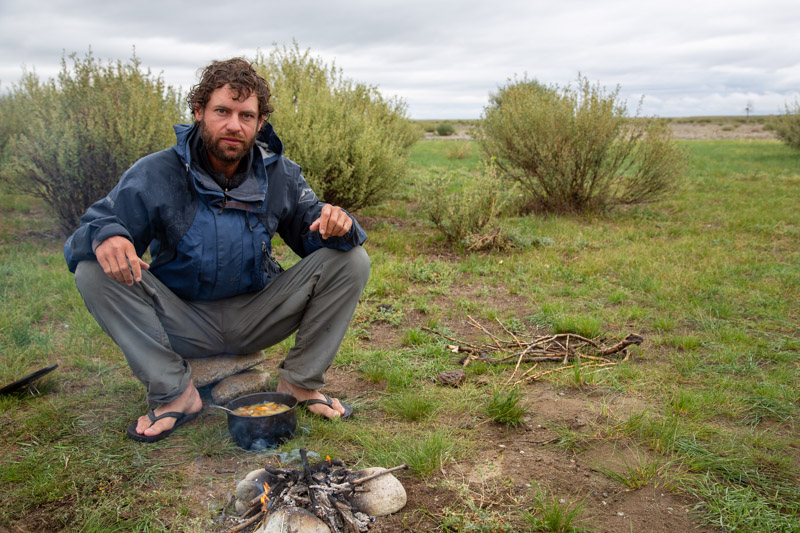
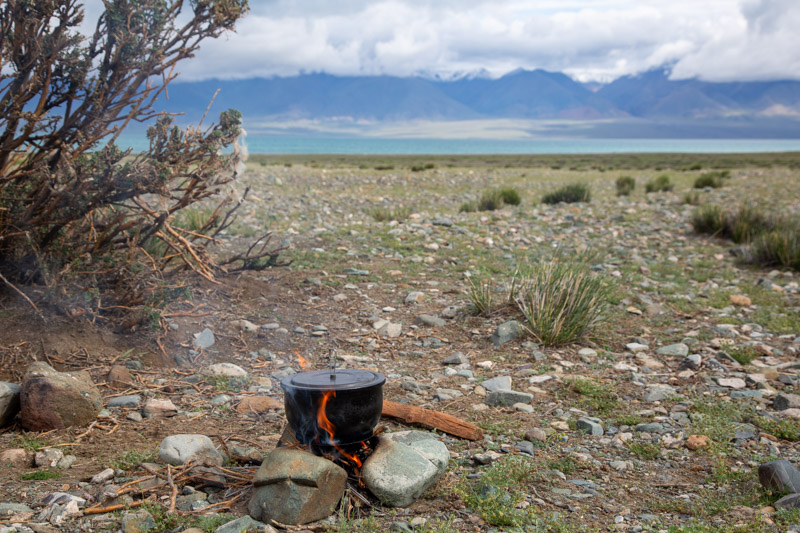
Once, I found vegetables in a store and celebrated by making two big pots of veggie soup.
Below, Kev and Mark motoring back to Dublin from Siberia. They were doing a comparable journey in two months on KTMs what would ultimately take me 14 months on a bicycle.

Having lost the southern route to Ulaangom via Hyargas, I had missed my only resupply point for 200 km, and was back to starvation rations of dried fruit. I filled up with 15 litres of water at the last flowing river marked on my map, and continued heading due west along 170 km of stone and sand corridor, flanked by the Togtohyn Shil mountain range to the south and the golden streak of shimmering dunes on the northern horizon. Three days later I arrived at Ulaangom so ravenous that I stopped at the first restaurant I came by, and had three enormous meals of beef and vegetables topped with fried egg. I don’t know if that dish would stand up to scrutiny, but there and then it was the best meal I’d had in my life.
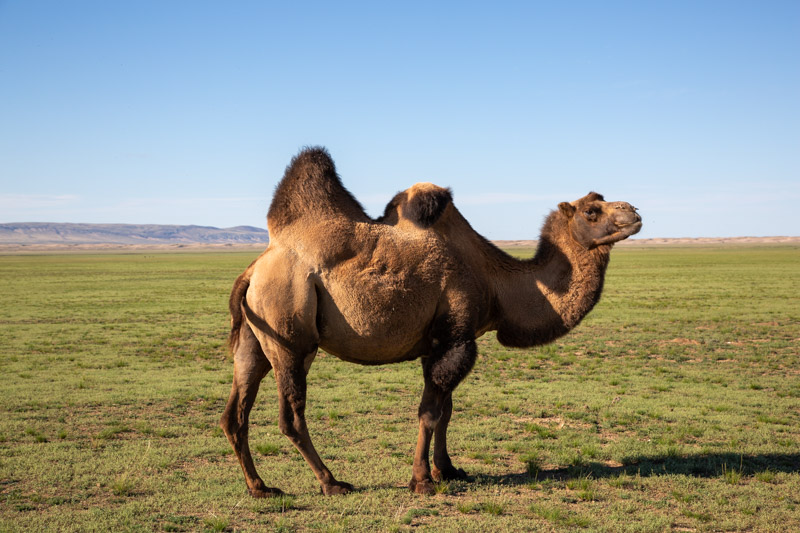
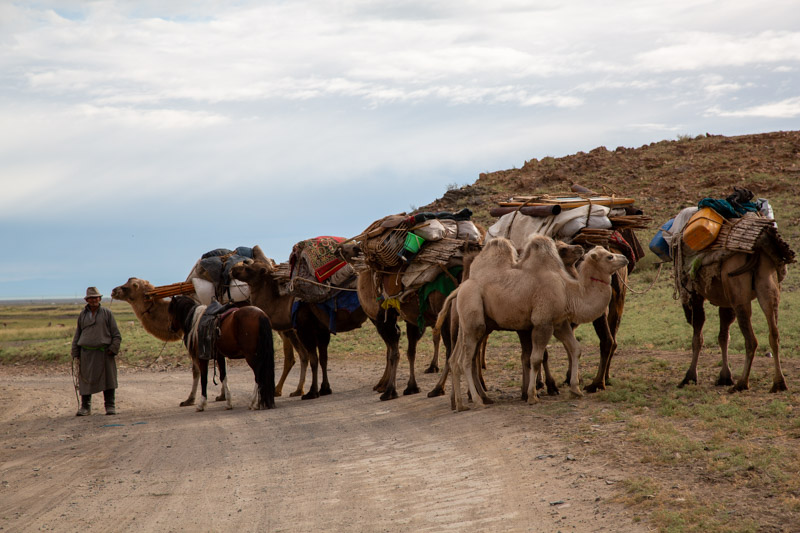
Moving camp by camel train.
275 km remained to the border, and studying my maps I knew this rough, mountainous slog approaching the Altai wasn’t going to be easy. There would be no villages, no resupplies. 275 km may not seem far, but in that terrain, with those elements, and that bike, I averaged 35 km per day. It would take 8 day to cover the distance. I had 10 days remaining on my visa. I loaded up with a weeks worth of food and 9 litres of water, and converted my surplus tugrik to roubles so I would be able to get food as soon as possible after crossing the border, then cycled out of Ulaangom at dusk, passed the concrete apartment blocks and urban ger camps, and into the scrubland north of this frontier town.


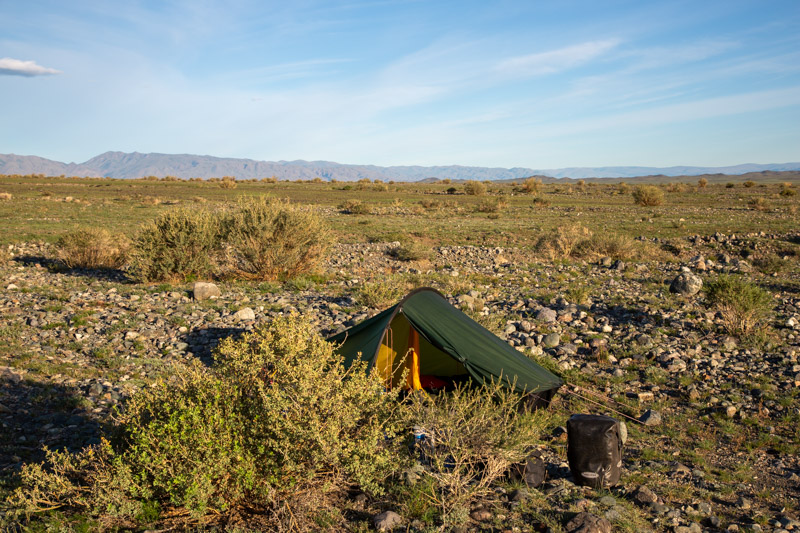
Uncomfortable camp on a rough patch of dry riverbed, 15 km NW of Ulaangom.
40 km from Ulaangom I grunted and skidded and pushed my machine for five hours up a steep mountain valley. A group of European bikers passed on cushy BMWs, and complained about how rough and tough the roads are. Oh yeah? really?
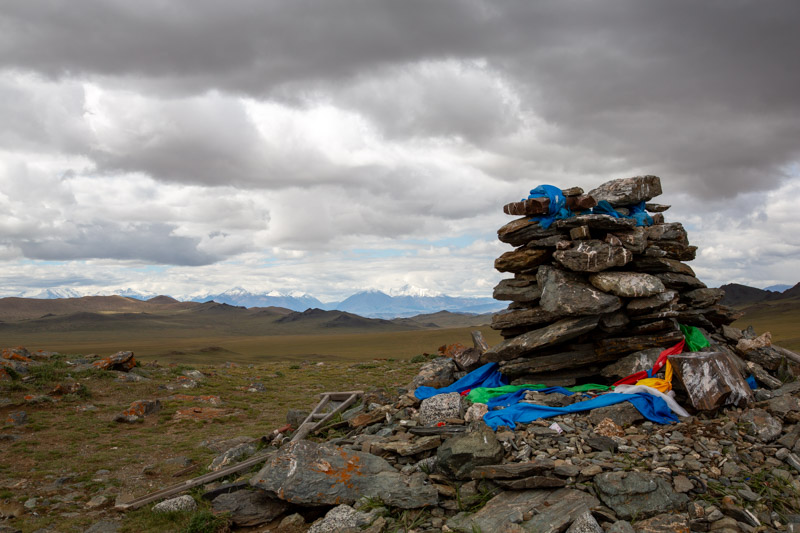
At the pass a blanket of storm cloud snuffed out the heat as I rested my aching bones and looked out over the twin valleys below me. A large ovoo (shamanistic cairn) sat at the pass, from which rags of khadag (blue ceremonial silk) whipped in the breeze. For safe passage travellers stop at the ovoos and circle them three times in the clockwise direction, and leave offerings to the spirits of money, food, and Vodka—the latter evidently being the gift of choice. Those spirits are floating around off their heads, for beside the ovoo were two bins overflowing with empty vodka bottles and shattered glass littered the ground. I never participated in the ritual because I’m not shaman, and I just couldn’t reconcile this spiritual practice with the desecration these mountain passes, which became trash heaps and manifestations of alcoholism.
I took in the view for a few minutes then rolled down into the relative shelter of the saddle to setup camp as the storm began to rip the sky apart. In the morning I packed camp in the icy rain and buffeting winds and headed over the western side of the saddle. The 30º gradient and rocketing westerlies were so exhausting I had to remove my front panniers and haul my bike up in bits.

The mountain pass as a an ugly heap of trash, shattered Vodka bottles, money, and crutches.


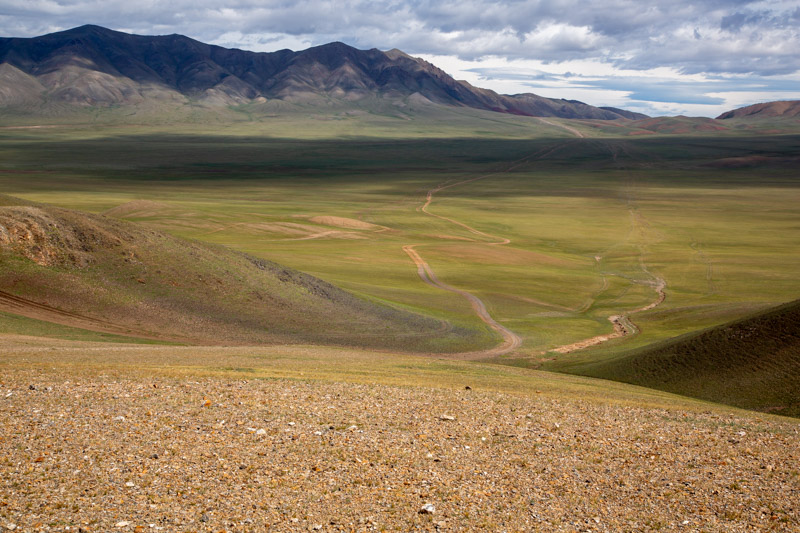

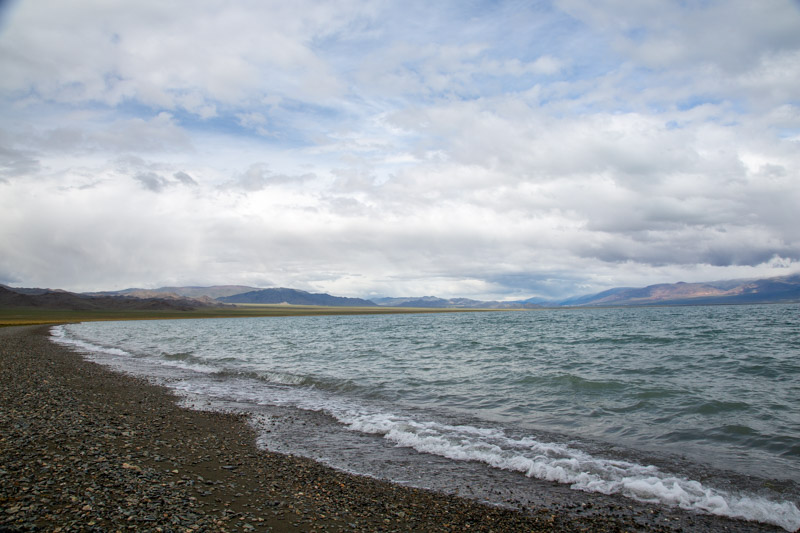
Uureg nuur
Descending to the aqua jewel of lake Uureg nuur, I meet a pair of French cyclists. They had travelled from France through central Asia, destination Ulaanbaatar. We talked about the visa requirements for each country they had passed—information I would need incase I was refused reentry into Russia, which was a definite possibility because what I was doing, um, let’s just say wasn’t exactly permitted. But as I was travelling in reverse the procedure for obtaining visas was still obscure. I could only be envious of the control they had over their journey; they could choose their direction, define their route, know all the place names, and after a few months get back home. I abandoned long ago any concept of what home is. It doesn’t exist. I was just trying to get to Europe, 7,000 km away, and negotiate the bureaucracy with a passport that had only three pages left.
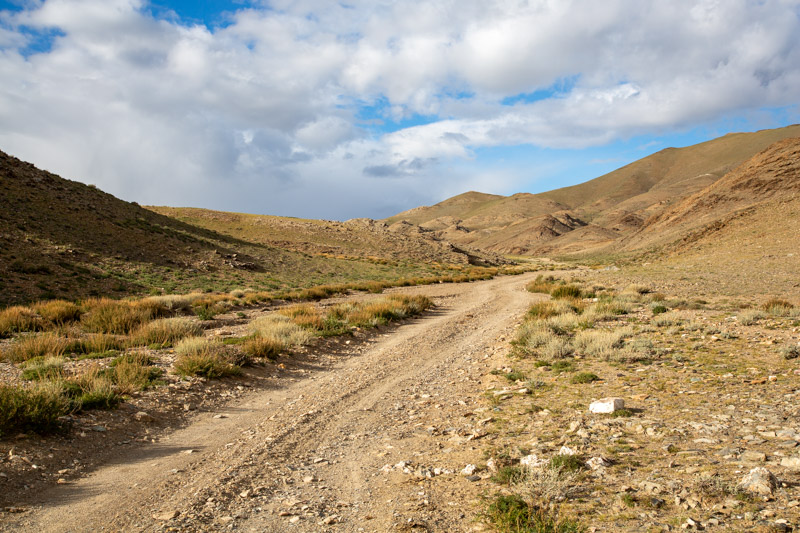
After three days in the mountains I descended from the range and thumped across 50 km of dry river bed. The loose river stones made cycling unbearable, forcing me to walk most of the way. My water supply was gone so I camped by a river, joyed with the endless torrent of fresh water to drink and swim in.



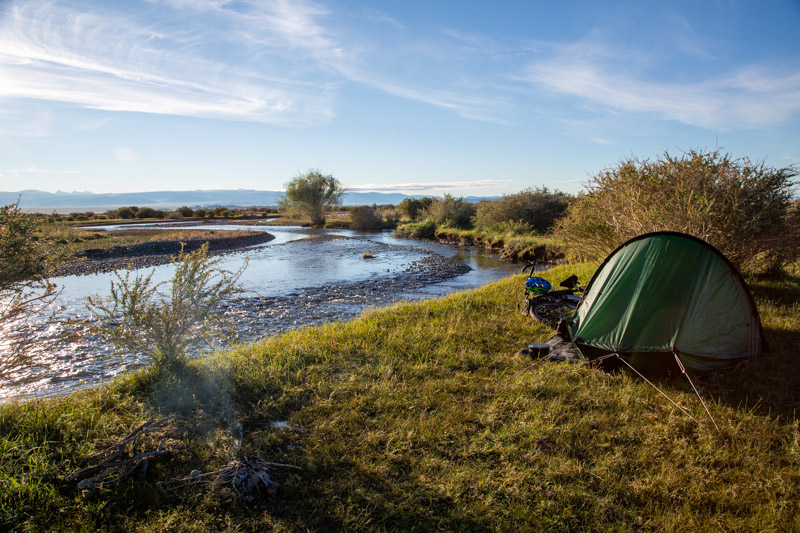
THE RIVER
The next night I arrived at my final river crossing in Mongolia. The dreaded Bohmoron gol. The few cyclists I had passed had warned that it was impossible, that they had to travel several kilometres north along the bank and wait for trucks to shuttle them across. A pack of herdsmen would discover my camp in the morning and deliver the same, pessimistic message. I told them I’ll be fine. I don’t need help. Which they thought was hilarious.
‘You can have my bike if I don’t make it,’ I said. Perhaps their thinking was already one steep ahead.


I setup camp on the east bank. The full moon reflected in swirls and splashes from the torrent cutting through the landscape. The dawn revealed an opaque, olive soup, churning along the bank into powerful eddies, swallowing chunks of earth in its flow. The river was definitely an obstacle, and though there was no way of telling the depth, there wasn’t any option in my mind other than finding my own way across it. The Challenge as it turned out, did not live up to the hype. I wove through the scrub about one kilometre north, where the river widened and split into two twenty-metre channels, and dropped to waist depth. There I unpacked my bike and shuttled my gear across in three trips.
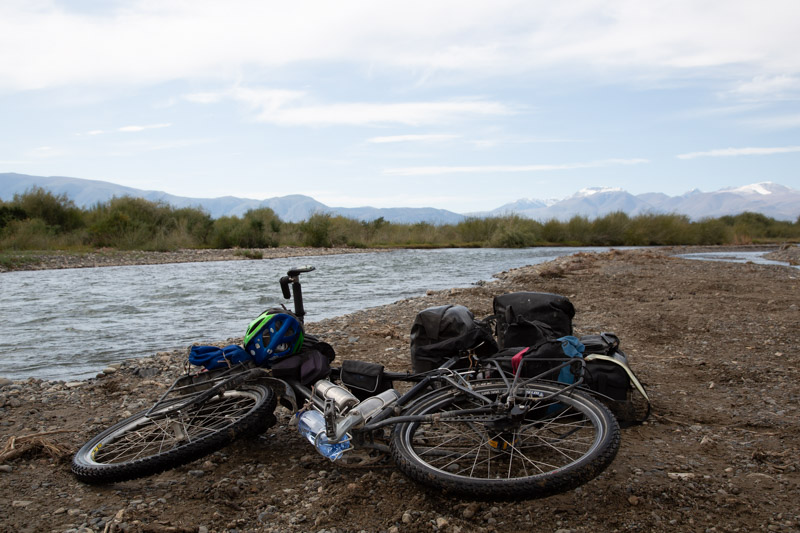
RUSSIA IN SIGHT
The undergrowth by the river was lush and the herdsmen were busy harvesting the pasture for winter feed. At the western bank an old woman gave me a thorny branch covered in delicious goji berries. While my shoes dried in the sun, I devoured these tart, yellow berries ripening on the trees along the shoreline.
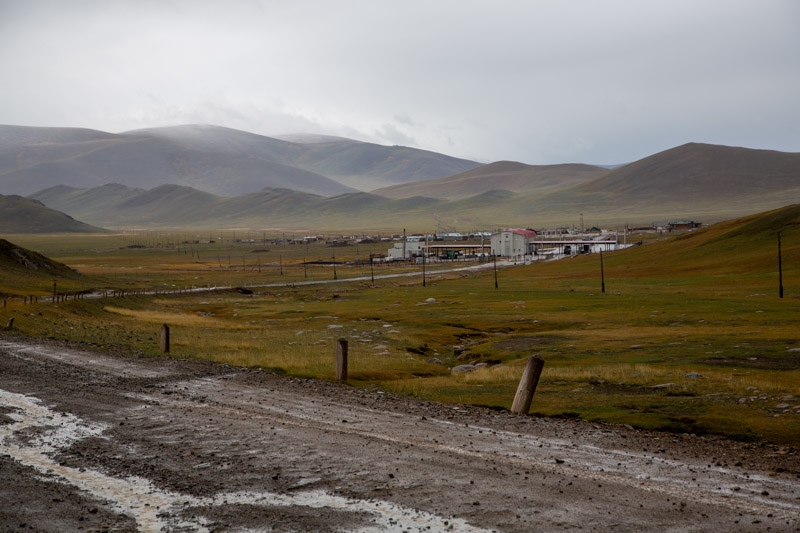
I had one more day cross-country until reaching the Altai Mountains. I had long lost the track and was travelling over virgin desert, but I could now aim for the wedge in the distant range indicating the plateau that would lead me to Russia. The western portion of the basin was flooded and spongy from a web of northerly streams, producing murderous clouds of mosquitos. I walked the final 15 km in fair weather over the stony terrain to the climb, taking in the final views of the snowcapped peaks in the north, the smoking gers dotting the landscape, the kids, the livestock, the wide open space. There was much to like about this beautiful country.

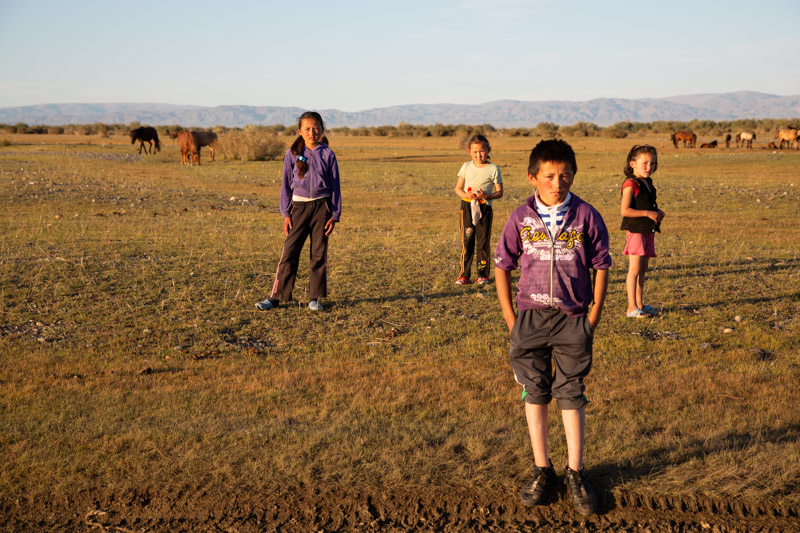

The steep, twisting gorge entering the Altai forms a wind tunnel, funnelling intense, westerly blasts of dirt and gravel. I laboured head-on into it at a marginally faster pace than a herdsman bringing up a flock of some 20 goats. He dismounted his horse and continued by foot once I had caught up—an act of curtesy I assume—and when I slumped exhausted by the river he joined me for the break. We rested on that grassy bank for about 15 minutes, just studying one another, but he never said a word. I guessed he was about my age, though who can tell how many years reside beneath the weather-lashed skin and dark eyes of steppe people—or a weary drifter for that matter.
I motioned to the river to check if the water was potable. Without muttering a word, he drew a cup from his tattered, blue deel, and drank a scoop of the river to prove it, then took another scoop and passed it to me. When I got up for the next push, he roused his goats and joined along. It seemed he wanted company, or perhaps he felt some kind of duty to offer me company being a vagabond in his land. Whatever the case, like so many strange encounters I’ve had on the road, the image of this gentle man moving slowly up into the mountains with his small flock of goats, is burnt like a lonely scar into my memory.


I arrived wrecked and ravenous at the plateau that would wind for the next 40 km before descending to the Russian gates. Ahead was lake Dund nuur, and at its western flank, the gloomy frontier township of Tsagaannuu. The road to town passes the northern bank, through a graveyard of soviet ruins protruding from the dirt like post-apocalyptic debris.
I had managed 50 km, was spent, and I wanted to get through it as soon as possible, but I kept getting accosted by people. One guy offered me a place to stay, which I declined. Then he chased me down on his motorbike, virtually begging me to stay in a hotel for free. The sun disappeared and I lost my way in the town looking for the road to the border. Again I rejected an offer to stay at a guys house, and he too came after me on his motorbike, and caught me 2 km out of town as I was digging my lights out of my pannier.
‘Muny people stay my house,’ he said.
‘No, thank you. I must keep going. Thank you.’
‘Muny, muny people. German, English, Mongol rally, stay my house. You stay. You sleep my house.’
This was not normal behaviour and it put me on edge. Tsagaannuu was a border town—a place for an outside to be on guard. I’d heard a story involving an English couple who after crossing from Russia into Mongolia, were invited to stay with locals and woke to discover their vehicle had been ransacked, their DSLR’s and anything of value gone.‘I’m going to Russia. I don’t stay with anyone now. Thank you, but I do not need anything. Do you understand?’
‘Yes. We are Kazakh. Mongolia people bad. We are good.’ I was told for the second time in the hour.
Of course people are not bad. Only bad people are bad. But this night I wasn’t going to take the chance. Perhaps it was unfair, but I had become so paranoid that I turned my lights off and cycled into the dark to exhaustion. Russia was within spitting distance, but the closer I got the more venerable I felt in Mongolia. Once Tsagaannuur had become but a faint glitter of halogen lamps, I stumbled over the rough ground, far from the road, to make camp. The sky had cleared, the winds dropped, and the moon cast mottled shadows across the steppe. And I crashed into exhausted, dreamless sleep.
I rose shortly after dawn for my ultimate day in Mongolia. Clouds inevitably rolled in and the sky turned a camouflage of melded charcoal, delivering squalls and icy rain. I filled my 4 litre water bladder from a mud-green river and hunched from the storm to cook a pitiful breakfast of instant mash potato, semolina, and coffee. The road carved out with rivulets and turned to sludge. The mud absorbed and chilled through my skin, my teeth clattering, my fingers waterlogged and agonisingly cold. But nothing mattered. I would make the border on the penultimate day of my visa.
Coming up: Russia Round Two
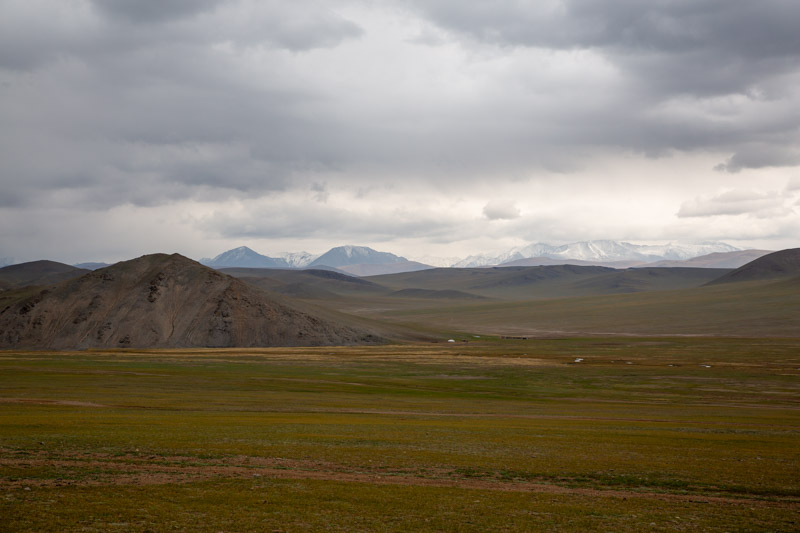
Looking NW towards the Altai mountains.
Below, my last view of Mongolia looking back from no-man’s-land.


 Earth Odyssey Expedition
Leave a reply to Greg & Brandon's Mongolian Motorcycle Adventure Cancel reply