
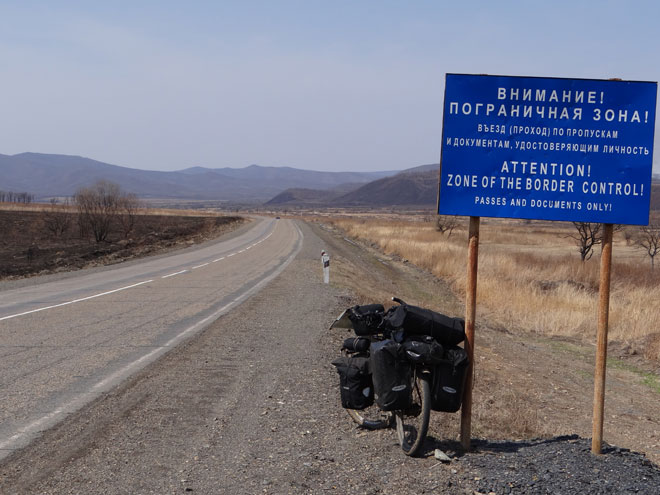

The Russian gateway was barely more than a collection of odd buildings set in a barren valley. Its presence marked by twirling clouds of gravel dust kicked up by each transferring vehicle. My feeble attempt to sneak through the gates was abruptly halted by an austere guard. ‘Bus!’ He demanded, pointing back the way I came with a stiff arm.
This is what I feared; no crossing between Russia and China is permissible by foot. I did my best, however, to try to cycle the few kilometres of no-man’s-land by pleading my case to three separate agents, but failed. Without my knowing, a Russian man bought two shuttle bus tickets and gave them to me as a gift, saying, ‘One ticket for you and one for your bike.’ It was a humbling final gesture of the beautiful Russian generosity that I’ve been so fortunate to receive throughout my travels in the Far East. Though I travel solo, I can hardly say I’ve been alone.
In minutes, I dismantled my bike and shoved it into the gaps in the cargo compartment, between the bulging cartons of Chinese merchandise, and climbed aboard the coach. 30 meters past the gates, I had to unload, lug the bike bits through Russian immigration, feed the x-ray machine, then stuff the lot back into the bus for the few kilometres to Suifenhezhen.
This was my second land crossing into China—the first was from North Vietnam en route to Japan. I was fast running out of pages in my passport—both Russian and Chinese visas took up entire pages and I still had a long way to go to get to Europe—so I wanted to ask the agent to put the stamp on a used page. The enthusiastic guard distracted me with odd questions, first in broken Russian, then in broken English: ‘Bike, money?’ ‘You need yuan?’ ‘You single?’ ‘Want to buy Chinese girl?’ I turn my head for a second, then ‘stamp!’ One more fresh page squandered on an entry stamp.
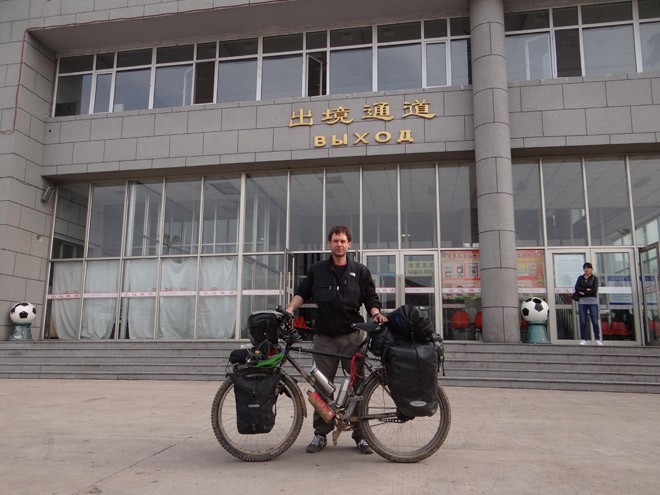
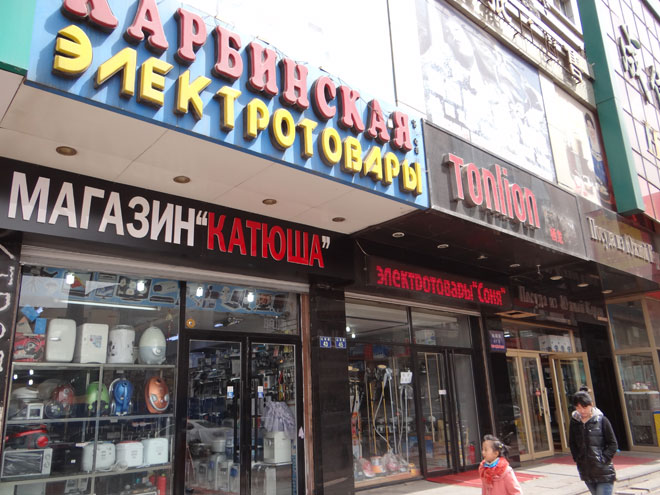
Suifenhezhen is a booming border city, supported by Russian consumers making trips from Khabarovsk and Vladivostok for bargain shopping and benders. Scaffolding, concrete and that artificial green glass only seen in China, rises from the dust and rubble that defines Chinese urbanisation. The neon, noise pollution and multi-national branding is a far cry from the Siberian village.
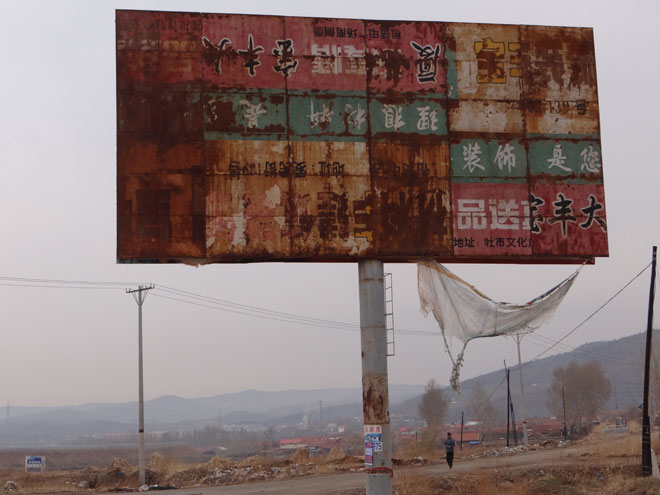
I cycled due west into nasty headwinds. Through the parched, post-winter land, I passed giant concrete structures with billboards of housing developments rising from verdant green gardens up to fictional blue skies.

The next three days I travelled a minor road wiggling through the undulating countryside, running through shanty villages and smoking industrial towns. The heat, fierce headwinds and a face full of dust and grit, made cycling rather unpleasant. At times the winds became so strong that walking into it was exhausting.



I stopped for food in a tiny bakery that produced steam buns and various types of cured meat. The shop owner, a beautiful friendly woman with glistening black eyes, dialled her phone and summoned her two teenage children to meet me. Her son had a good comprehension of English and his mother watched with delight as we communicated. Before I left she refunded the money I paid for the food and gave me two bottles of water and a large bag of buns; produce that I assume she could ill afford to donate. She refused any payment, her son told me, because I was the first foreigner that had ever visited her store.
I rolled away in the late afternoon, back into the headwinds. The noise of people going about their business, boisterous children playing in the dirt, the clatter of machinery and occasional passing vehicles, the entire sound scape seemed to fade away in the wake of that encounter. It’s that indescribably special thing some people have, the ability to show love to a complete stranger.
For a few days the winds shifted to favourable north-easterlies. Whole communities of farmers worked barren lands, tilling fields with bullocks and noisy two-stroke plough machines. Clunking rang out across the land. Seed was sown by hand. Peasant farmers buzzed around on clapped-out motorbikes, spraying fields with pesticides.


These friendly policemen waved me down and gave me water.

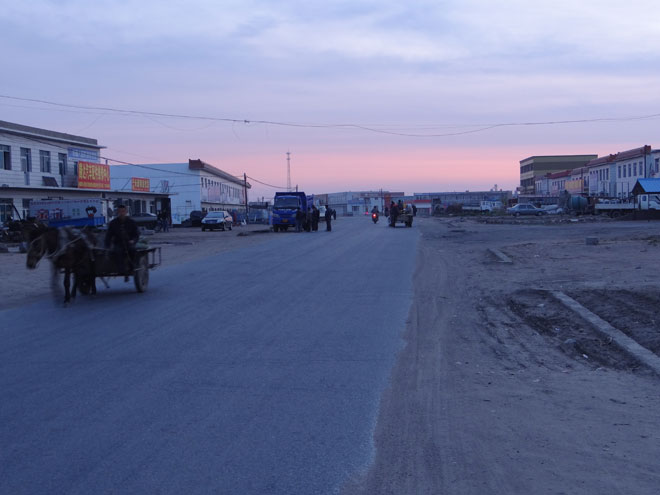
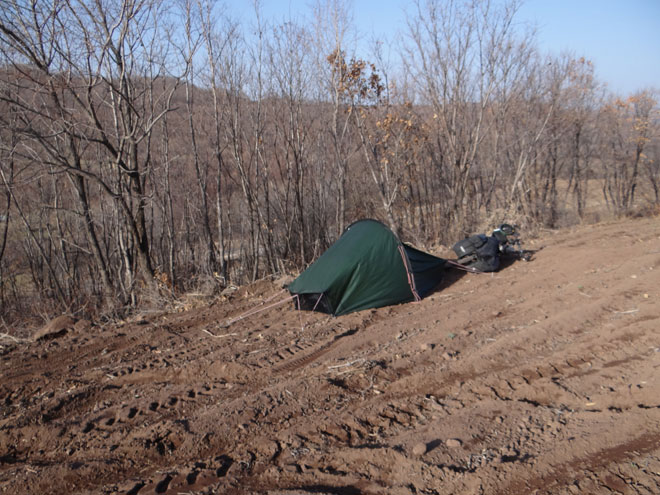
The novelty of being back in China began to wear off with the reality of the repressive conditions—the impoverishment, the trashing of the environment, the lawless road culture, the impatience. Subsistence living takes advantage of every opportunity: every speck of land that can be cultivated, is; wild edibles are harvested from the roadside; rubbish is scrounged for food; entire mountain valleys are quarried. For three weeks my spirits were sucked out of me as I pushed into hot headwinds, rolling through dilapidated villages, choking on bad air, camping in patches of dirt at the roadside or between fields.
I anticipated heading south-west to the Himalayas and crossing the Tibetan Plateau, but discovered that China has closed Tibet to foreigners indefinitely due to unrest, protests, and acts of self-immolation. Rerouting through Mongolia and back into Russia was the logical route to take given my northerly position, and that I had a year on my Russian visa. As I travelled deeper into China, my thoughts shifted to Mongolia and I became set on the prospect of getting back into nature. The Himalayas, I had to concede, was another journey.
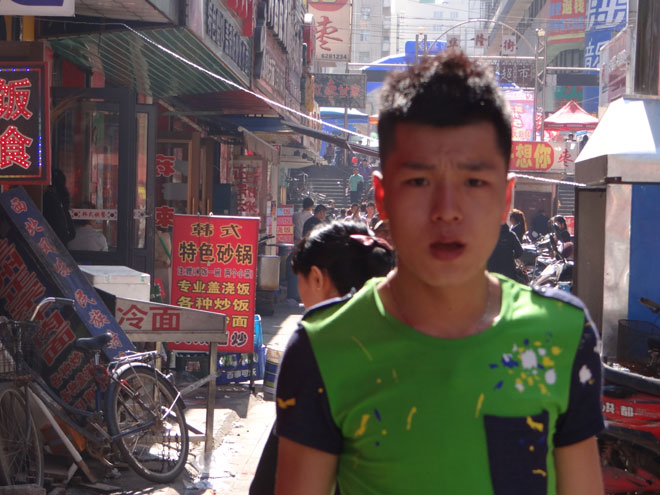
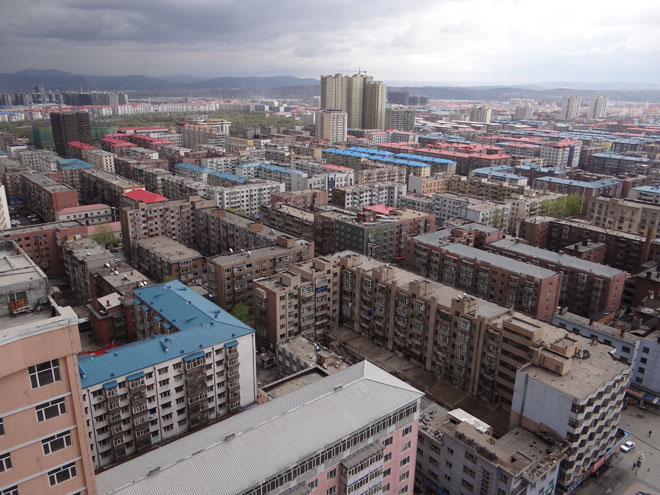



I preferred entering cities in the mornings, when you can get all sorts of yummy hot meals at the markets. This man made spicy egg cooked in dough. I ate 6 of them.

I arrived in Tongliao, at the south-eastern corner of Inner Mongolia (Chinese prefecture), still hundreds of kilometres from Mongolia but the last major city before crossing the border. It was my final opportunity to get bike spares for the remote Mongolia section. I tried to source parts along the way but came up empty handed, so I left my bike in a hotel and caught the train to Beijing to try to source the spares and do a little sightseeing.

Dinner party and cards at my friend Emma’s apartment in Beijing.

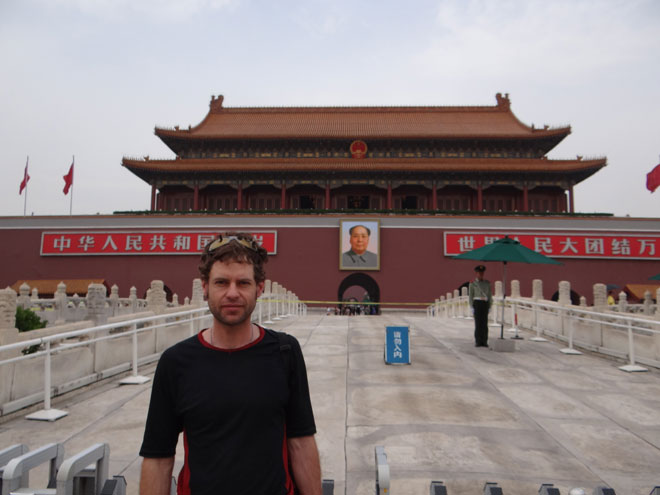
Tiananmen Square
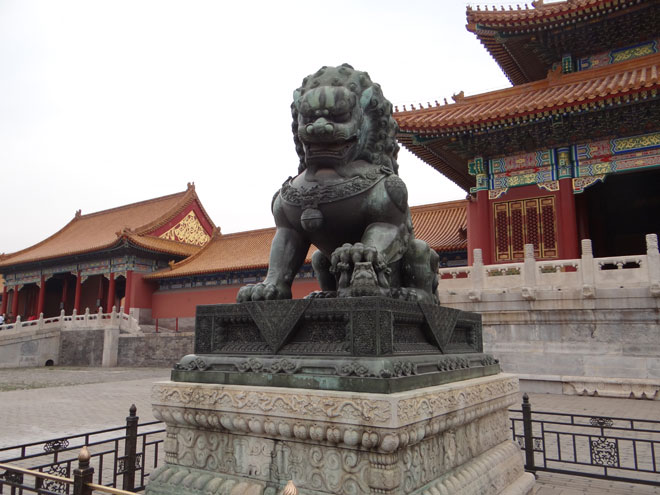
The Forbidden City


798 Art Zone

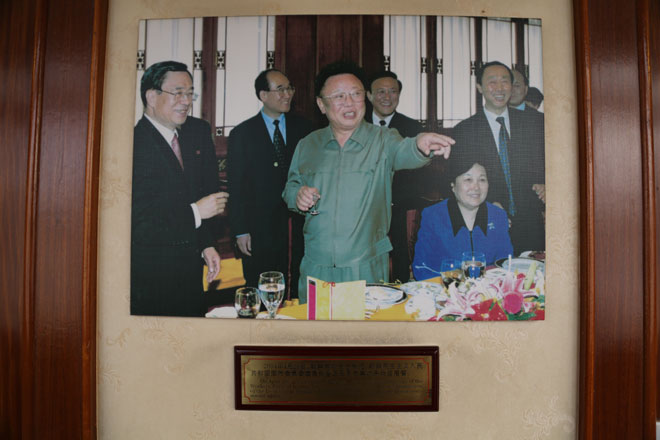
Beijing Quanjude Hepingmen Roast Duck Restaurant. Had Peking duck at the ‘largest Peking Duck restaurant in Asia’. At 200 yuan for half a duck and a couple of beers, It was the first extravagant meal I’ve treated myself to since leaving Japan, but it was worth every yuan. Absolutely superb!
Corridors feature photos of dignitaries and tyrants who’ve dined there.

Usually my meals looked something like this and cost around 6 yuan.
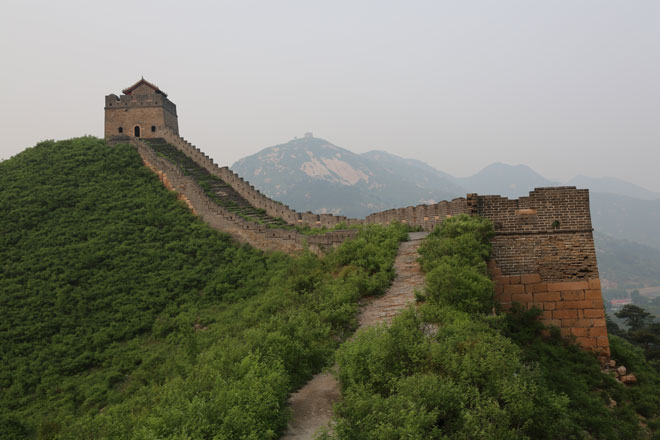
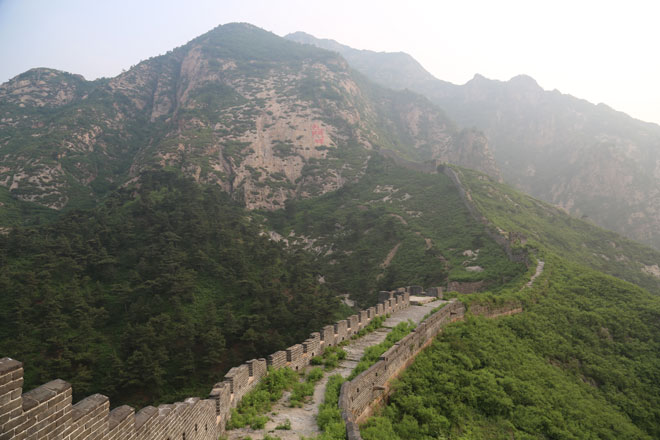
On the train ride back to Tongliao, I stopped at Shanhaiguan. There I caught a taxi to the Jiumenkou Great Wall—the only section built over water. This section of the wall was virtually void of tourists.
Back north in Tongliao, people scattered for cover, cowering beneath eaves and in shop fronts to witness the beauty of an electric storm. Water gushed out of gutter pipes randomly protruding from building facades. Heavy hail resulted in citywide flooding. I departed in the late afternoon riding through rivers and lakes formed in the depressions of the streets. In the dimming day I cycled west into the country through gales and heavy showers that conspired to release a second round of thunderous rage. I took cover under a spindly mop of a tree being wiped around in the turbulent wind.
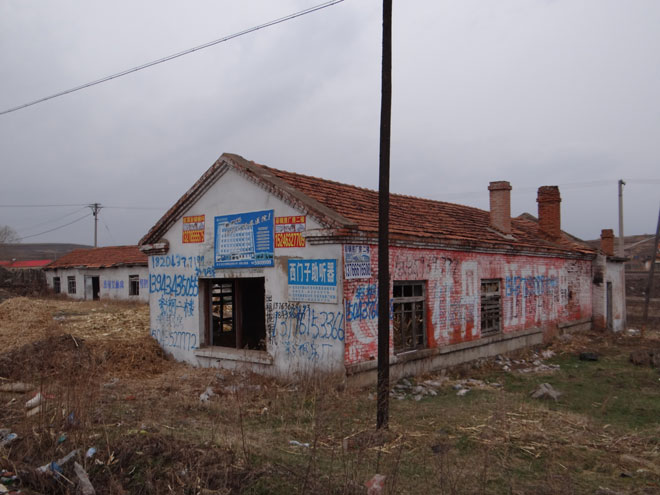
12 km out, I stopped for water at a small village which, like so much of rural China, seemed to be weeping beneath the drizzle and crumbling wreckage of poverty.
A guy I met at the shop deplored my being in such miserable conditions and invited me to follow him, but instead of taking me to somewhere sheltered, he lead me straight to the police office. A group of shabby, partially uniformed men surrounded me. Somewhat perplexed, they requested my ID, but I was more concerned about escaping the miserable weather so I pointed to a cell and gestured a sleeping action. They laughed, but made it clear that I was not welcome there and pressed me to return to a hotel in Tongliao. No thanks!
Further on at the edge of the village, I stopped at a restaurant and fumbled through my notebook to order a meal. Across to my right, I watched a group of family and friends scoffing down a huo guo (hot pot) and racks of dumplings, and back to the chewy, oily chicken dish placed in front of me, regretting with each mouthful the limited menu items scribbled in my notebook.

This man and his daughter invited me to sleep at their restaurant.
After my meal the family kindly invited to sleep in a dining room to the side of the restaurant. Lying on a thin mattress by the window, I watched a plump spider flapping about in the wind. A red lantern spun in the gale. Boisterous chatter and bursts of laughter penetrated the walls; the incomprehensible noise of foreign language, the audio of my surreal existence.
The family were up early preparing the restaurant, sweeping the floors, rearranging the tables. I ordered tea and dumplings for breakfast. Two young guys arrived on a motorbike and invited me to join them for stinky fish huo guo, and together we knocked back shots of baijiu (50% liquor) until a fresh bottle was drained. Then they ordered a round of beers. It was 6:30 am.


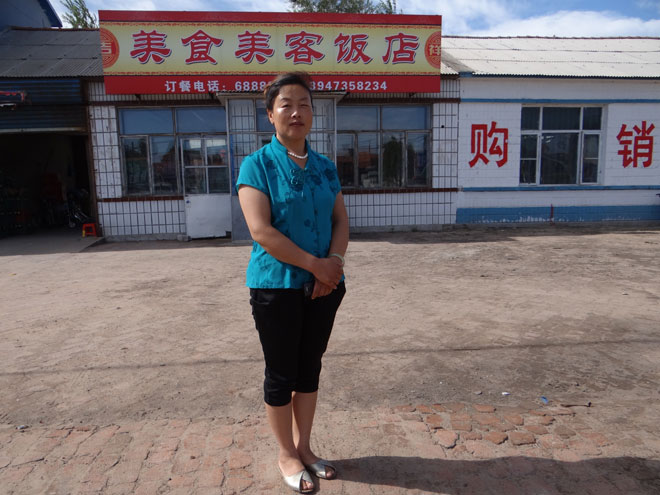
For the second night in a row I was invited to stay in a room at the back of this ladies restaurant.


I enquired where I may get a fed in town and these lovely people showed me to their restaurant and cooked me a delicious beef fried rice gratis. One of the best things about touring in China is the enormous size of the meals.

At Kailu—a small city with two main streets—a young woman helped me check in to a cheap hotel. The receptionists looked at the police notice mounted to the wall by the desk (probably for the first time) that states foreigners are prohibited from staying at the hotel, but my local help discreetly urged them to let it slide. There I learned that only certain—generally expensive—hotels are allowed to accept foreigners. I avoided accommodation as much as possible, only staying in the occasional hotel when I craved a shower or was passing through a city.
Eating dumplings at nearby restaurant, two guys at the neighbouring table excitedly tried to communicate with me, using their phones to translate and calling friends with limited English to answer questions. ‘My friend wants to invite you to dinner,’ came the voice on the line.
‘Now?’ I asked. I was already eating dinner. ‘Ok!’ I agreed.
The guys jumped up. ‘You, let’s go!’ One insisted.
‘I haven’t finished my dumplings. Or my beer.’ I said, pointing to my plate.
‘You, now, let’s go!’ He demanded again, throwing some notes to the waitress for their meals and mine.
Sure, why not? We drove through the town in pouring rain, in his black Volkswagen Passat to a nondescript restaurant, climbed the stairs to the second floor and entered a small cubicle dinning room, where four friends were eating huo guo. Two of the girls there could speak English well enough. ‘Polease,’ one of them said, pointing out my host.
‘Please?’
‘Polease. Polease.’ she reiterated.
‘Police?’ I asked.
‘Yes. Polease, polease, polease,’ she repeated pointing to each member of the dinner party.

Before long bottles of beer and baijiu began to flow. What was likely to be a simple dinner turned into a major piss-up with the local police squad, ending in a karaoke booth with everyone belching soppy Chinese love songs. After we were all drunk, I was delivered back to the hotel (the one that’s forbidden to take foreigners) and shown past the receptionist and up stairs to my door by the group of inebriated police officers. The next morning at checkout, the nervous hotel receptionist disposed of my room receipt and with it evidence of my stay.
Farmlands were giving way to rolling grasslands. The few fields that existed were producing little more than stunted crops from the sandy soil. It was getting hot. I stopped at a servo for water. The pretty young casher gave me a hug as the boss snapped some pics with her cell phone. They were curious about where I sleep, eat, etc. With minimal English she asked ‘Eat, my house?’
How could I refuse? It was the first time I had been invited to a rural home. I followed her motor scooter over lumpy, muddy roads a few kilometres through the countryside to a small, brick village. I entered her property through tin gates and a chained dog let out a few lazy barks then retreated back to the shade. A red tractor and bits of machinery and farm equipment were scattered around the yard. At the southern side was a vegetable patch producing lettuce, tomatoes, spring onion and various other unfamiliar produce. Along with her mother, she cooked up a banquet of delicious dishes while I hung out with her young husband in uncomfortable silence. After the large feast and a litre of beer, I thanked my hosts for their wonderful hospitality, before wobbling off down the road.


If only it could be like this everyday!

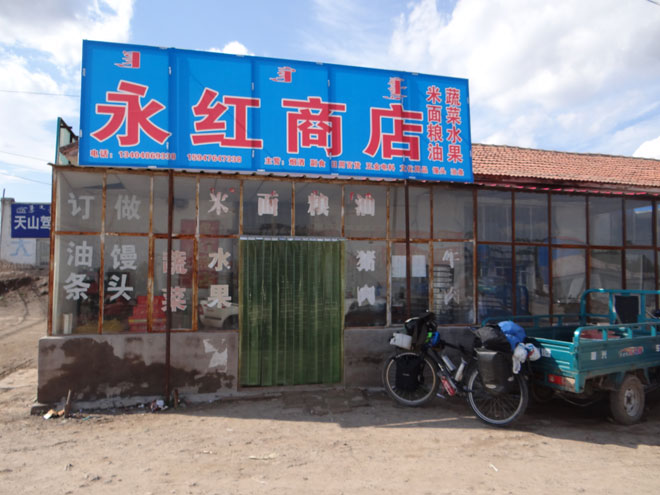
This is a typical village shop where I would get water and ice-cream.
By evening I arrived at a small city. Another water stop produced a small crowd of onlookers. I was ushered into a restaurant by a friendly man for yet another free feed of dumplings and beer. Despite my protest, these beautiful people would often refuse to take payment. Their kindness was thoroughly undeserved. A storm was brewing and he urged me to stay in the city so he showed me to a small hotel. While negotiating with the reception, his wife stormed in and gave him a hiding (don’t know why). With that, we move on to another small hotel a few doors away and the staff refused me entry, which riled him and he retorted angrily.
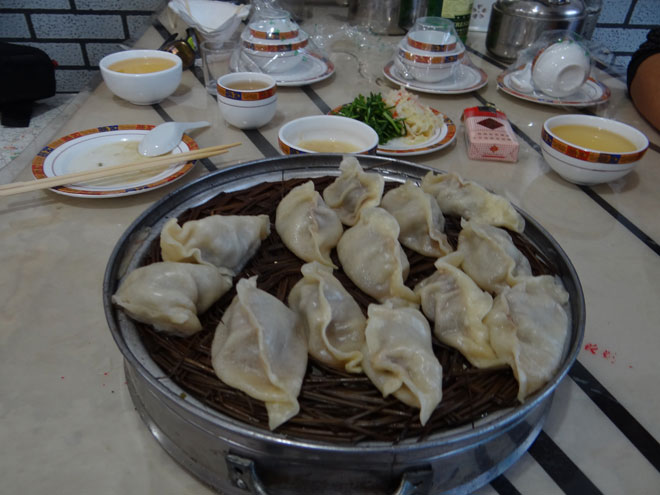
One of my favorite places to eat. Dumpling restaurants often had open kitchens, where you can watch them hand making the dumplings.
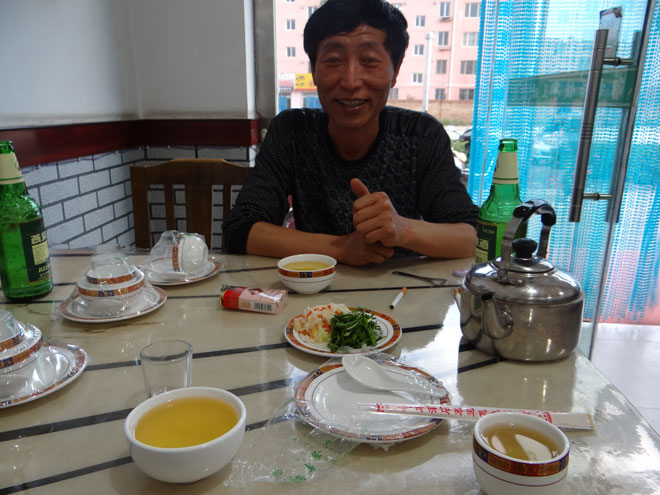
A crowd formed around the action. The receptionist shook his head at my disgruntled friend, while the wife was getting even more worked up. But I felt strangely calm while someone else was dealing with this farmiliar situation. Eventually family members were pulling the man away and telling me to ‘go’. Frustrated, my friend threw his hands up to the absurdity of the situation. I cycled into the stormy night to make camp 30 minutes out in torrential rain.
As I was drying my gear and packing camp in the morning, a rare group of cyclists passed and invited me to join them. 30 km away we stopped for a picnic at a parkland. More cyclist from the district arrived. A banquet was laid out and slabs of beer unloaded from the car. I clinked beer cans with a cheeky young high school teacher. Though slight, she could drink. She knocked the can back in one. ‘No,’ she protested at my sip. ‘You must drink it all!’ And that was the theme of the afternoon. I joined the cyclists heading west to Bairin Zuoqi—a small city in the foothills…(don’t know the name of the range as maps in English don’t exist). The hot afternoon ride was punctuated twice by electric storms and hail.

Pick the odd one out.

In town, Wang Guiyi, a member of the cycling group, checked me into a hotel and generously paid for my room and treated all to a superb round table banquet, featuring a menu of many delicious local dishes that otherwise I’d never know—the best meal I’ve had in china. They invited the English teacher along to translate. ‘Do you like drinking?’ Kathy asked, using her English name.
‘Sure, I usually have 1 or 2 beers with a meal, and sometimes more if it’s a party.’
‘Tonight it’s a party so you must drink a lot,’ she told me.
As the beer and baijiu flowed, I realised I was at a serious disadvantage. In China, I’ve learnt, you don’t cheers just once then drink at your own pace, but rather drink at the same time as others. In other words, every time someone clicks your glass you’re obliged to drain it, before it’s promptly refilled. I had been doing that all afternoon and as I was guest of honour at a large gathering, my glass was working overtime at the dinner also.
‘Bottoms up!’ Kathy said, checking to confirm if the expression was correct. ‘Perfectly!’
Kathy’s English was good, and I apologised that she was dragged out on a Sunday evening to work as my translator. She told me she was lucky to have the opportunity to speak English. I knew that I was just as fortunate. ‘I suppose you don’t often met foreigners here,’ I enquired, wondering how much practice she gets way out in northern China.
‘You are the first foreigner I’ve spoken to in 46 years,’ she told me.
‘How old are you?’ I asked.
‘I’m 46.’

My friends from Bairin Zuoqi, who did everything they could to help me and show me a good time.
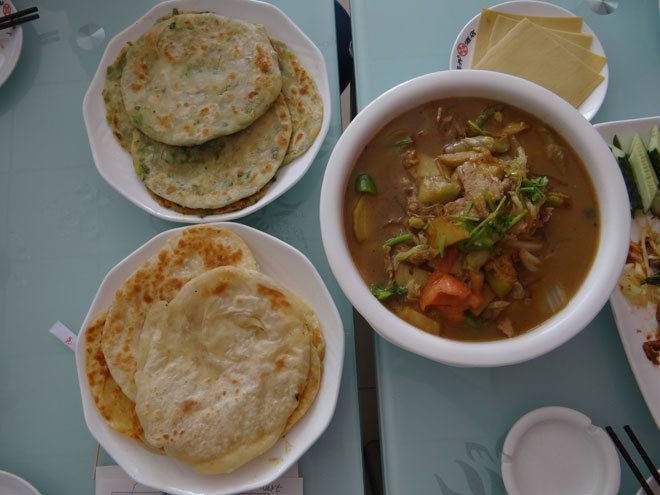
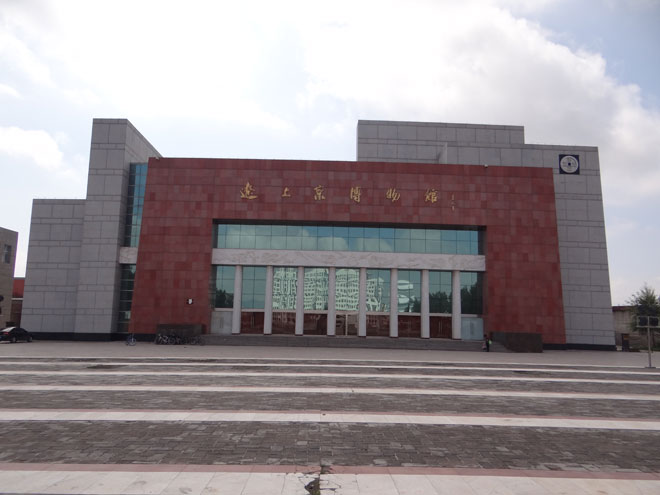
To my surprise, the next morning they organised the local museum of history (usually closed) to open just for me.
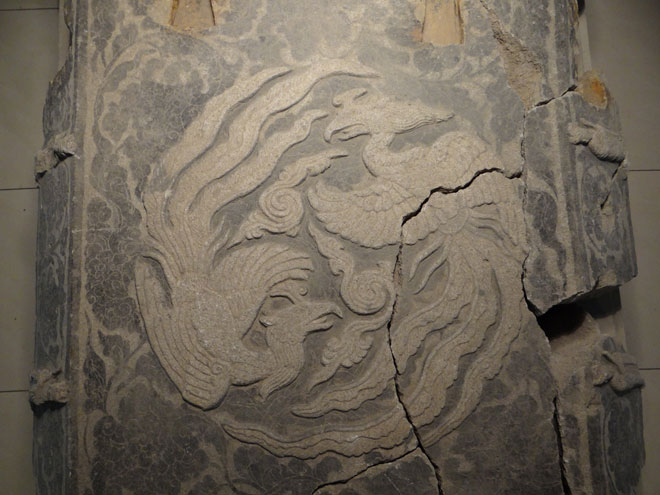
Phoenix on a casket.

From Bairin Zuoqi I considered which route to take: the easier southern highway route or the mountainous but quieter northern route. I decided on the latter hoping it would yield a new view of China. The road wound up a wide valley between verdant fields, passing tiny brick villages. Horses and donkeys tethered to palings, fed on dried cain scraps.

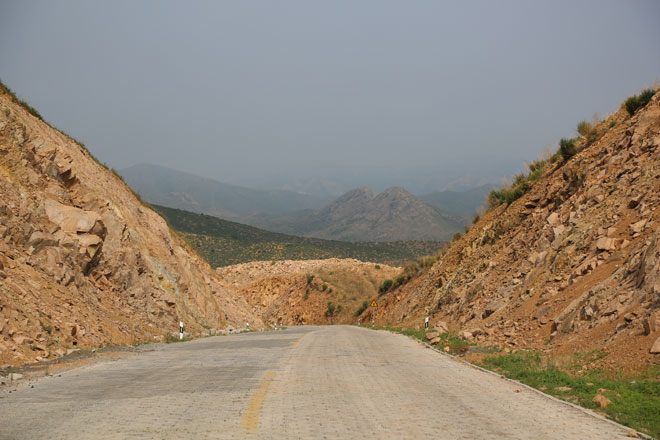
Farmland mostly vanished, replaced by sandy grasslands of the lower Gobi. Over night, I went from months of nightmare camping scenarios to treeless grasslands that stretched to the horizon with barely any sign of man. Yurts appeared. Cattle, sheep and horses roamed free. I crossed four passes before arriving at the open lands on the northern side of the range.
For the next 500 kilometres I travelled over rolling steppe. It was a relief to finally get through the more challenging part of the route, but progress was slow for the prevailing summer westerlies that I had been fighting for two months were intensifying. Somedays I was averaging 10 km/h (less if I was walking) and struggling in the heat to do 50 km. The only spec of shade available was from the occasional road sign. I would sit in the shade, lethargic from the heat and headwinds, drink water, listen to audio books and not moving for an hour.


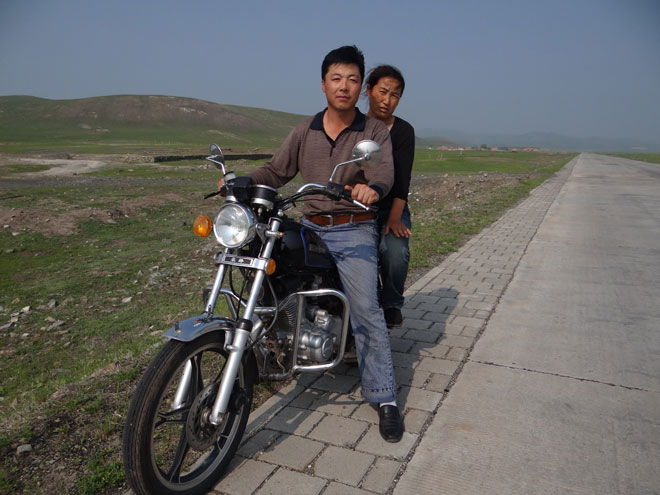

Genghis Khan

Genghis Khan’s younger brother. Looks like a tough bastard!

My favorite kind of restaurant—with pictures on the wall.
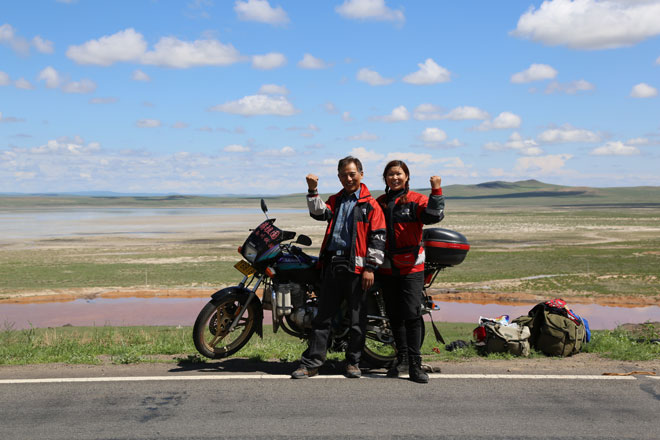
Past a chinese couple motorcycling around China, patching a tube roadside. First road travellers in 7 months.

A few hours later I past a chinese man in his twenties cycling to Beijing. Notice the bag of steam buns on the handle bar; I did that too.
Cycling out of town, I was stopped by a policeman in a 4×4. ‘I don’t speak Chinese,’ I told him. He did a u-turn and demanding me to follow, but I didn’t know what he was saying, so I acted dumb and continued on my way. That really pissed him off as he had to turn his vehicle around again, banging his horn and screaming at me like a madman. Oh, will you piss off! I muttered, but had no choice but to follow him back to the station and went though the routine (for the second time) of entering various offices, while half a dozen people scrutinised my passport and visa. I was shoved in the back of a police van and two of his subordinates drove me through the streets to a printer to get the thing photocopied. Only two more stops and I’ve made it. Let’s not blow it now.
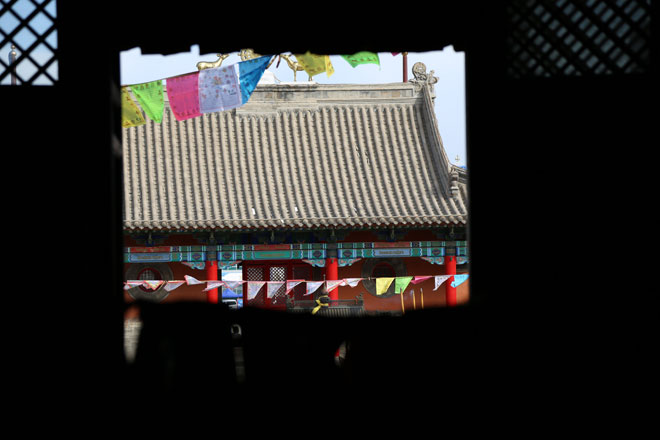


Another restaurant encounter, another piss-up!


In Erenhot—my final stop in China on the Mongolian border—I met the first foreign travellers on the road since departing Japan seven month ago. Konny, Andi, Nico and Stephanie are returning to Germany from Australia in a pair of Land Cruisers. No doubt travelling China in a vehicle has its advantages but one disadvantage they faced was having to pay an absurd fee to take a government minder and being confined to certain main routes, as is the law for motorised vehicles.
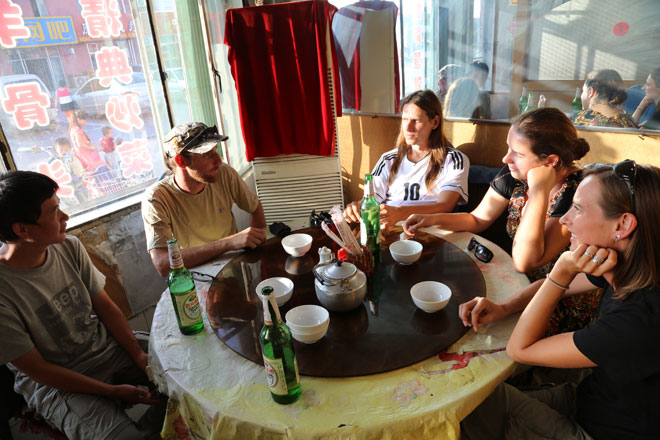
Konny, Andi, Nico and Stephanie from Germany, were the first foreign travellers I met since leaving Japan. Their government minder is on the left.


 Earth Odyssey Expedition
Leave a reply to Fap Turbo – How Much Money Can You Make With This Robot? Cancel reply