
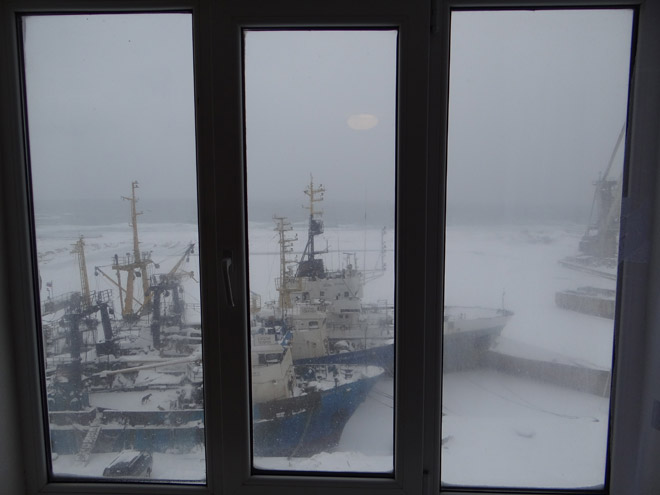
I arrived in the small township of Nevelsk, on the west coast, exhausted and with frostbite on two fingers on my right hand, and on one blistered toe. I spent a few days recuperating, treating my extremities, and readjust my gear in an old brick boarding house. Footsteps and chatter and snapping locks echoed through the corridors like an old prison. From my fifth-level room I looked out over the marina at rusted hulks entombed in sea ice. The weather had deteriorated into blustering northerlies and heavy snows. I wondered how long this could keep up. Days? Weeks? Never mind, I was going north regardless.
The staff treated me like family. I was invited to eat at the cafe each day, but the girls never accept payment for my meals. On January 13, I received a knock at my door, calling me to celebrations for the ‘old Russian new year’. The party developed into a vodka intoxicated haze and I ended up stumbling around wearing a police ushanka (Russian fur hat). My friends from Nevelsk were genuinely concerned about my winter travel plans, but all I can do is assert that I’m prepared and know what I’m doing . . . err . . . sort of.
Mad! Crazy! It’s a common reaction, perhaps a compliment, though I think people more rightly see of me as naive. There are other cases of crazy out here, such as young women getting around the Siberian climate in stockings and stilettos. Absolute insanity though, manifests in barking fits tethered to snapping chains at every house and hovel. It’s hard to see, dogs gone berserk with chain-rage.
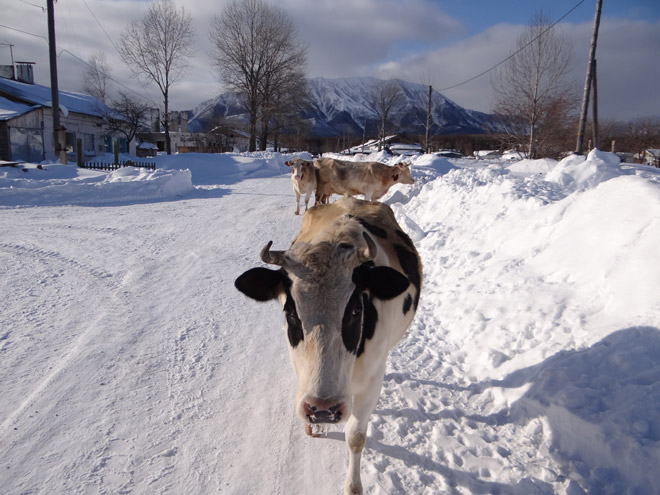
The poor conditions continued unabated but I had to push on. I had one final meal at the cafe, hugged my dear friends goodbye, zipped up, and now with an abundance of energy, cycled into the blustering snow. I followed the undulating coastline, passing tiny timber villages. The early winter ice floe was collecting in coves and inlets along the rocky shore. I rolled past derelict shacks half submerged in snow, and all but lifeless if not for the yapping dogs. A stubbly old man surrounded by mangy animals, appeared from one squalid hovel, looking vacant and spooked. I have arrived at the edge of the world, in another time.
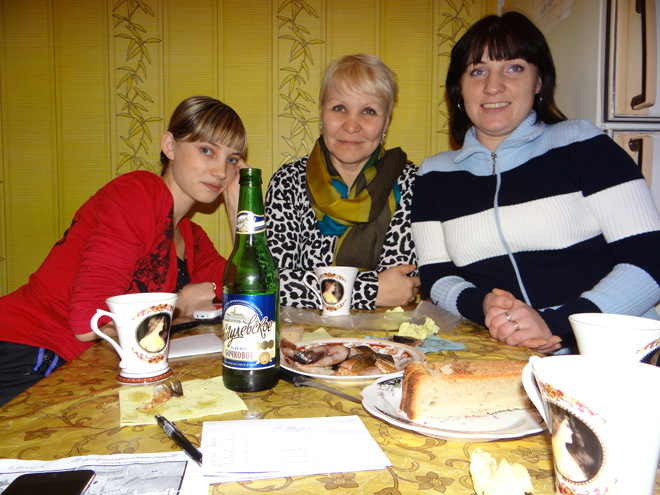
My friends from Nevelsk welcomed me with beer and delicious smoked fish.
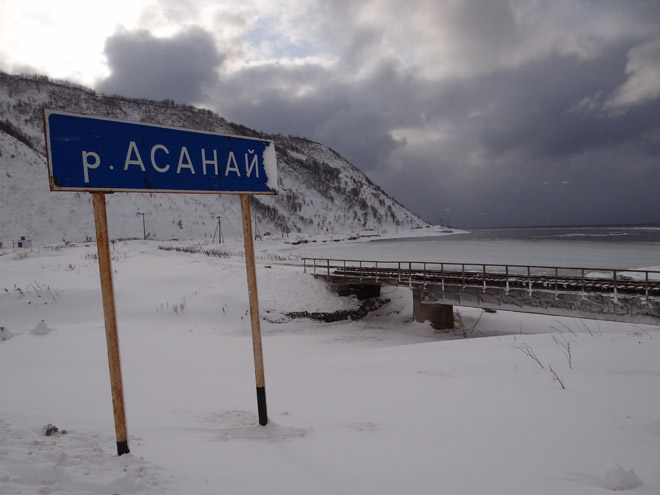
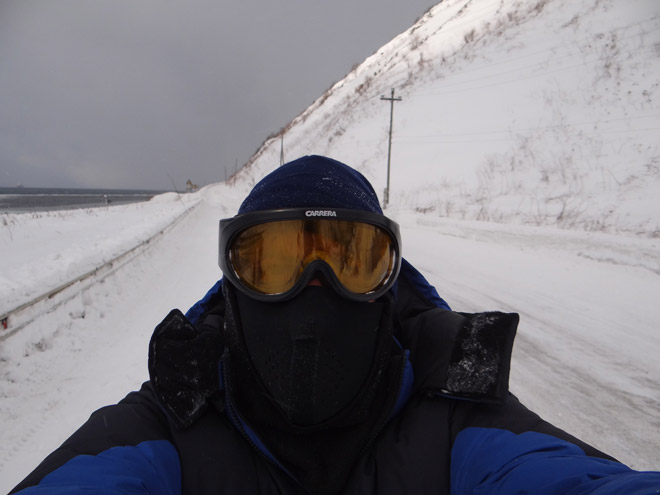
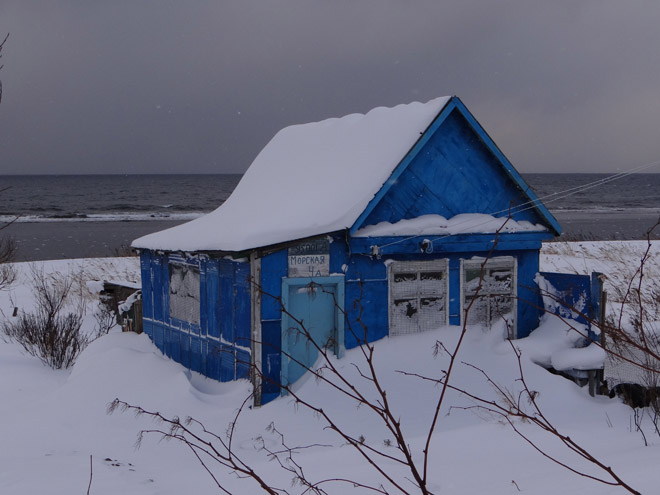
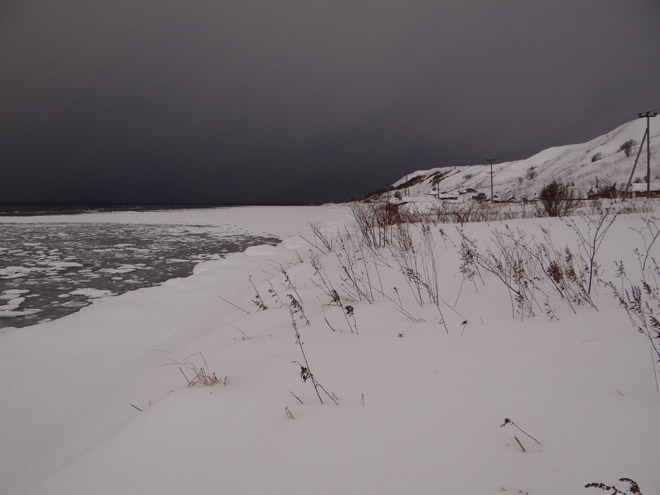
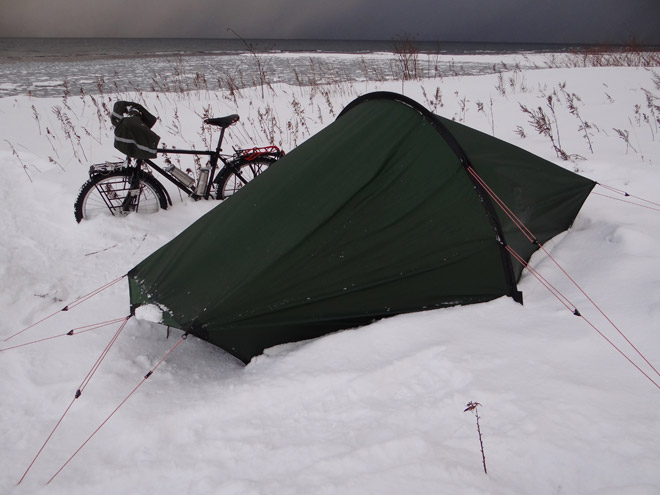
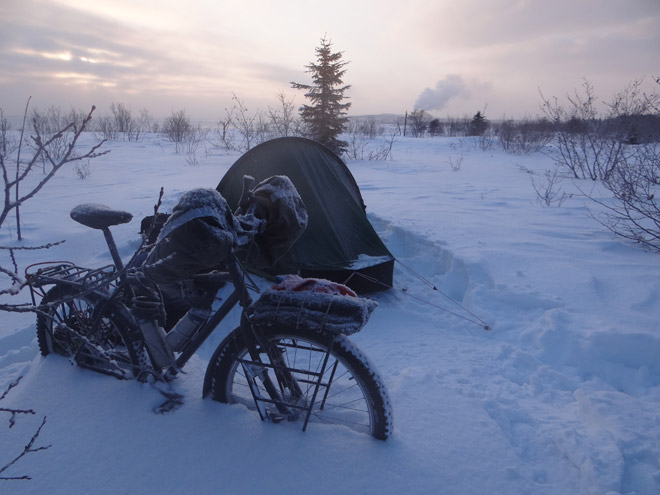
Nearer Kholmsk the road passes through a series of small villages. Smokestacks belch opaque billows of nauseating pollution. I was cold, my neck and checks tingling and numb from the snow driving through the gaps in my headwear, but the greater discomfort of the contaminated air forced me to swap my face shield for the pollution mask. Once through the worst of it, I picked a vacant area a few hundred metres between dwellings and performed my nightly routine of strapping on my snowshoes, dragging my gear through the snow, and pitching camp.
The weather was clearing, the traffic was light, and I felt good about heading up the west coast. My plan was to cross to the east via a pass a quarter way up the island, but it was heavily discouraged by the people who enquired about my journey in Kholmsk, due to heavy snows and blocked roads ahead. The locals were adamant that the only way north was back from where I had come, from Yuzhno-Sakhalinsk to the east coast. My futile protest only aroused more concern, and before I knew it the gathering had convened to determine what to do with me. It was settled; I would get a ride back to the capital city with the grocery truck driver. Knowing that a failed attempt would cost some six days, I grudgingly agreed, and spent the afternoon crammed between the two delivery men in the front cab of the truck, as we bounced and fishtailed back over the icy pass, which I had so greatly struggled to cross the week before.
From the city it’s a days ride north to the coast. I bought a loaf of bread and leant my bike by a corridor of snow that lead out to the frozen sea. The sun was shining but my hands struggled in the bitter cold, cutting the bread and slicing chunks of salo—the heavy block of salted pig fat that had been lovingly given to me for warmth and energy. Performing the simplest task can become a painful and laborious cycle of removing and replacing gloves, warming hands in armpits, hunkering down from the wind, and doing the job in bits.
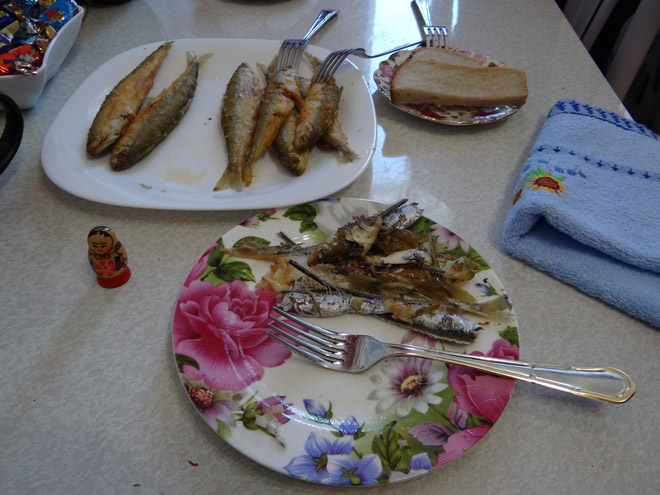
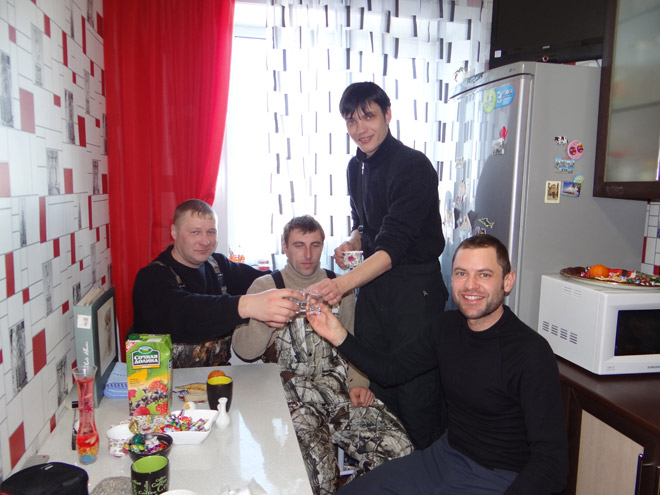
Fishermen shuffled past with big rubber boots and puffy clothes, carrying ice drills and buckets full of freshly caught fish. There I met Pavel and Liza as they were heading out onto the ice for some fishing. After a brief chat they aborted their fishing trip and invited me into their home for tea, where we could communicate better using google translate. Liza cooked these delicious fish for lunch. Some instant friendship, a relaxing afternoon in a warm apartment, and a few shots of vodka, seemed cruelly short lived as I cycled away late back into the frigid world.
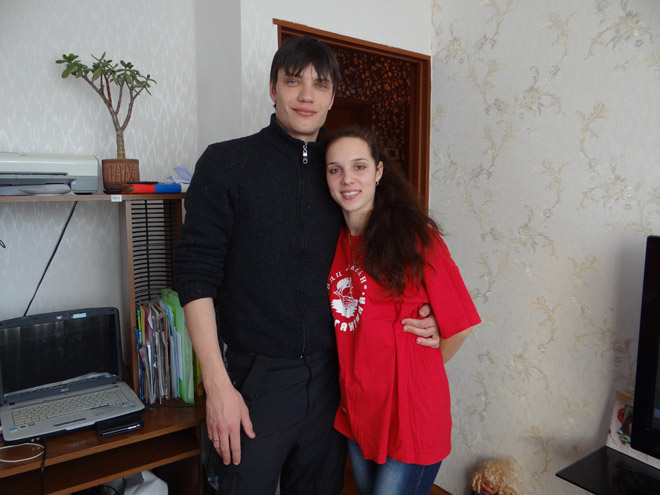
Pavel and Liza aborted their fishing plans and invited me into their home for tea and tasty fish they had caught the day before through the sea ice.
Without forest in the vicinity, I camped behind a snow dune about 20 metres from the deserted stretch of road. I feel uneasy if I know I can be seen, and at some point in the night I woke to the sound of a truck engine idling nearby. My heart jumped, anticipating boots crunching through the snow towards me. It was -33ºC, so to extract myself from my cocoon and prepare to exit the tent to deal with anything hostile would take 10-15 minutes at best—a task not worth thinking about. Fortunately the truck left without disturbing me, but still it turned out to be a very uncomfortable, sleepless night as my feet got progressively colder. I feared that if I fell asleep my toes would freeze, so I spent the night doing all I could to keep circulation in my feet.
I also discovered as I was setting up camp that I had dropped my 1 litre stainless steel water bottle and insulation bag. It was bad news because that bottle is able to keep liquid in a liquid state most of the day, while my other bottles freeze over almost instantly. Knowing that it would be difficult to replace, I had to find it before getting snatched, so I set my alarm for 6:00 AM, allowing two hours to break camp—not an easy task at 30 below when I spend most of the time jogging on the spot with my hand firmly implanted in my armpits. Regardless, I managed to get the job done by first light (08:00) and retraced my track to find the bottle 500 metres back. It was a huge relief.
In this environment the loss of just about anything I carry can be a game changer. I’m constantly checking and rechecking my gear, slapping all six panniers and bags attached to my bike to be sure everything is secure and packed, such as my sunnies and mitts. Travelling in the frozen world is serious business and you have to adapt quickly because there little room for error.
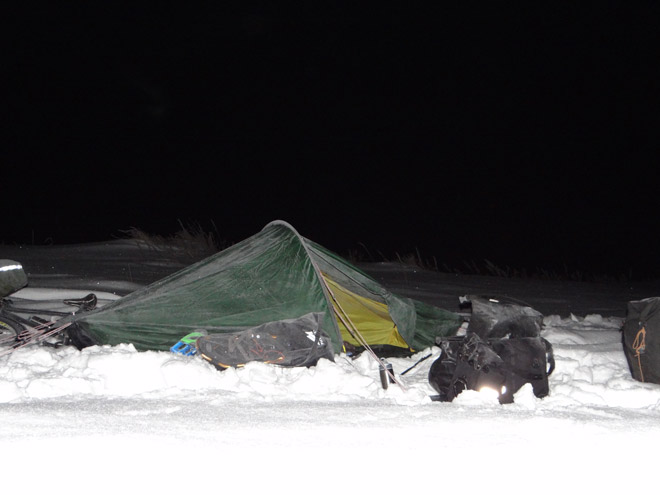
Struggling in the deep freeze to break camp before sunrise and go in search of my precious water bottle.
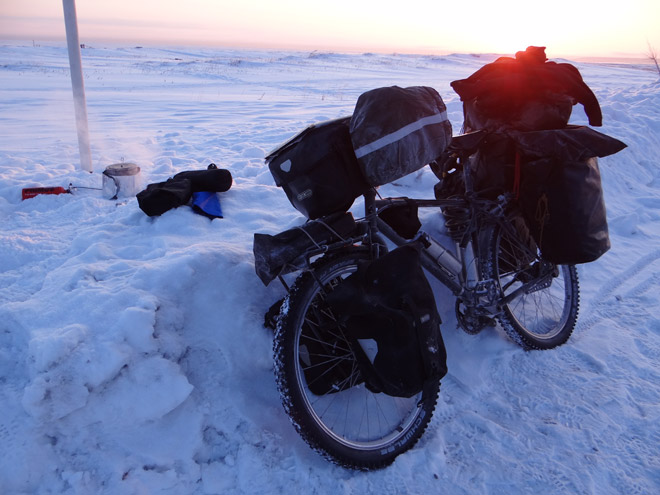
After I recovered the bottle I had to fire up my stove to thaw it out.
A pickup truck pulled over and offered me a lift. I’m not sure if people pity me or if they are just excited to find an eccentric foreigner, but whatever the case it happens occasionally and somehow I must communicate that I’m actually doing this out of choice. A few hours later I came to a construction site for a new bridge, and the guy from the pickup met me on the road with a big smile. He introduced himself as Ivan and pointed down the hill to the workers camp. Gesturing eating from a bowl, he asked, ‘Yum-yum?’
‘Yum-yum! Da! Yum-yum.’ I said, delighted and ravenous.
I bounced my bike down the rough, frozen track to the camp and entered the kitchen, where two women prepared the meals. They must have been expecting me because the table was set for one with starters of potato salad and bread. With barely a word said, I was served a large bowl of noodle soup and a fatty dish of meat and rice—a typical Russian winter meal. This first experience at a construction camp was a revelation.
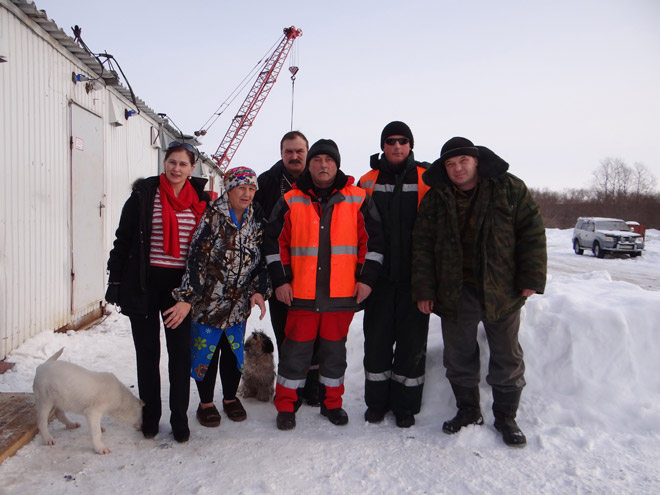
The wonderful people from the construction camp that invited one cold, hungry traveller in for a hot meal.
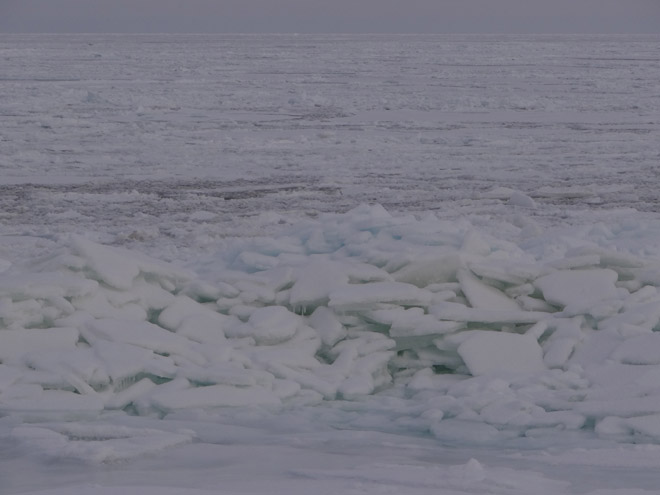
I’ve been moving slowly up the coast, entering the coniferous forest of the taiga. The Sea of Okhotsk to the east has turned white. Mobilised by seasonal winds and currents, the sea ice that has been amassing along the east Siberian coast since October, is on its annual migration over the north of Sakhalin and down along the east coast, until it finally banks up along the northeast of Hokkaido—the same stretch of coast where I lived in northern Japan. I often rode my bike to the coast and walked along the beach, watching the ice floe grow daily until finally submitting the powers of the ocean into a dull, frozen calm. Today there is no ocean, just a blanket of white sea ice extending out to the North Pacific horizon.
Cycling beside the ice floe takes me back to Japan. I think about what I have and haven’t accomplished. Did I spend my time well? Did I learn all I could while I had the chance? What were the lessons? Am I any wiser? It reminds me just how finite experiences are, how easily life passes by if we don’t pay attention. I wish I had more time to take it in but there’s not enough hours in the day, or days in the year, to make sense of it all. At some point you have to move on.
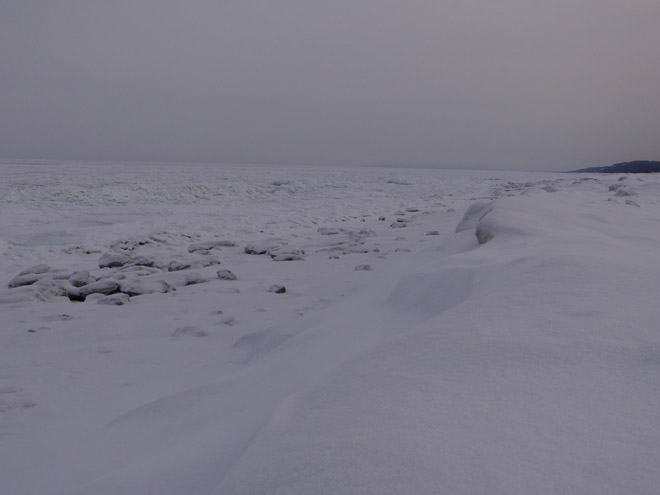
The ice floe has to be seen and heard to be appreciated.
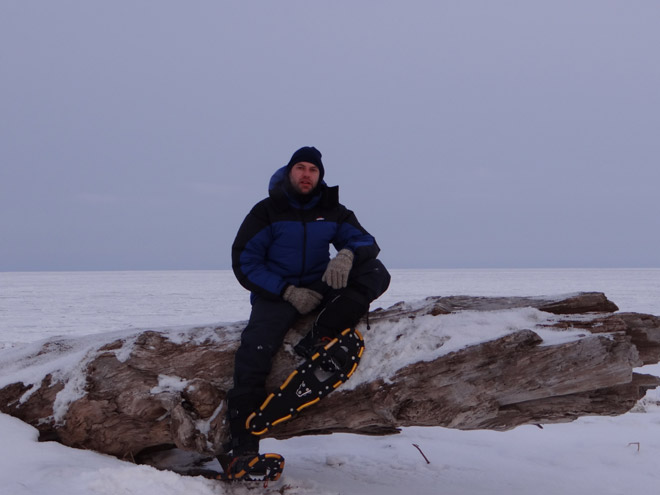
My thinking was that one advantage to travelling in winter is that the bears are hibernating, but when I mentioned it to someone soon after commencing the ride, they squashed this assumption.
‘Niet! Not fish in river, not sleep bear.’ I was told with alarm.
‘Oh, I see. This year fish in river?’ I enquired.
‘Niet! This year not fish in river.’
Oh shit! By that stage I’d been warned about every little thing, and was experiencing some kind of RED ALERT overload. And frankly, the possibility of a few rogue bears didn’t bother me that much. But the dark has a habit of playing mind games, and lying in my cocoon that night in the forest, I couldn’t distinguish if the sounds entering my head was the slight rustle of the fly sheet over ice or a hungry bear sniffing at my feet. Suddenly I heard foot steeps outside. I froze. It became louder and vibrated through the ice. I held my breath . . . then I gasped relief. I realised the disturbance was not outside but actually my heart pounding through my chest.
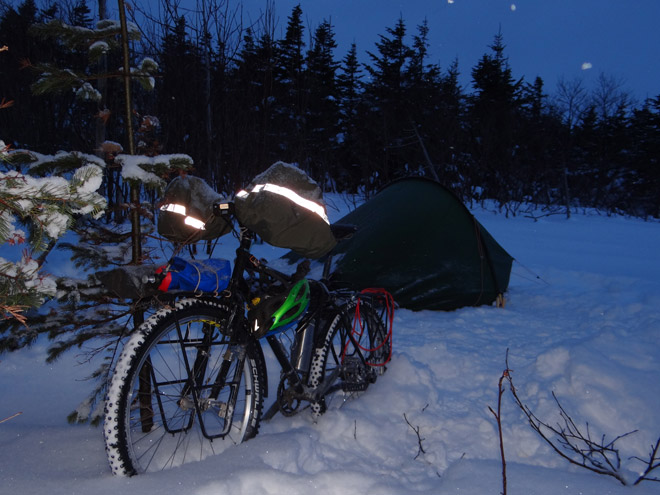
No footsteps in the snow, just sounds in my head.
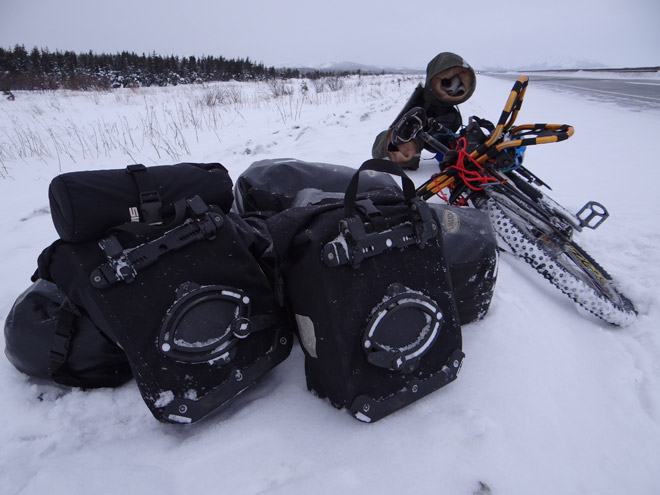
My gear in a pile each morning after lugging it out from a secluded campsite.
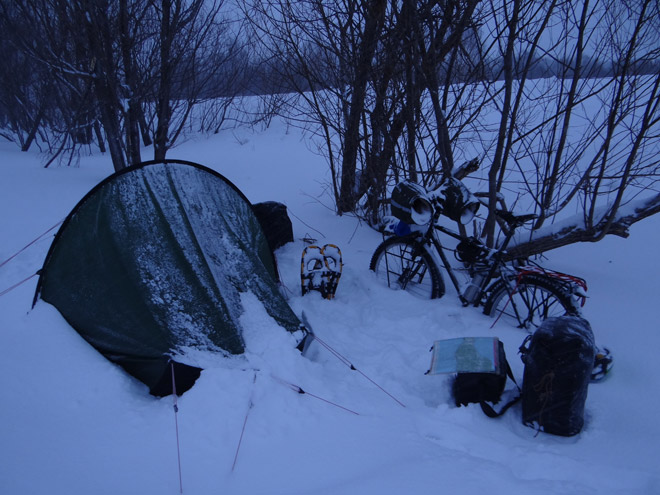
Back on track I was battling into the northerly blizzard. The road diverged inland from the coast and traversed a series of exhausting passes that took two days to cross, with my 65 kilogram bike thumping disagreeably over the frozen, potholed roads. A 24-hour warm spell saw temperatures rise to around 5 below—just warm enough inside my tent to melt ice and drench everything in condensation. My down jacket became soaked inside and out. Soon the temperature plummeted again, freezing my jacket and rendering this crucial piece of insulation useless until it could be thawed and dried.
Getting down gear wet, even from perspiration, is a cardinal sin of cold climate survival. I use a body size plastic bag, that I bought for 130 yen ($1.50) at a home centre in Japan, as a vapour barrier liner inside my sleeping bag. It’s horrible to sleep in but necessary for extended winter trips, as it stops perspiration being absorbed and condensing inside the down, which adds weight and destroys the insulating properties. To that end, I also use supermarket bags over one thin pair of socks inside my boots, otherwise I would be putting my feet into blocks of ice each morning. So essential it is that I keep my down jacket dry and functioning day after day, I don’t use it for any kind of aerobic activity anymore, especially not cycling. Instead, I underdress, sweat less, and bear the excess cold.
Occasionally vehicles stop for a chat. The weather was miserable when four construction workers pulled up in an UAZ-452 (Grey Russian van nicknamed Bukhanka, bread loaf). They wanted to know what the hell I was doing out here. Two of the guys got out, and one of them, quite drunk, was aggressively trying to knock me off my bike so he could load me into the van and drive me to the safety of a town.
‘Palatka. Palatka.’ I protested, trying to explain that I sleep in a tent.
The man was so disgusted I was camping that his comrades had to calm him down. Frustrated, he threw his hands in the air and stormed back into the car. After they realised that I was just some madman that wasn’t going to get off the bike, they served me up some bread and salo, and a shot of vodka, and wished me luck.
Back on the coast, the savage blizzard pounded down from the north, occasionally flipping to the east or west and knocking my bike sideways. I was covered from head to toe in Gore-Tex, gloves, goggles, and headwear to shield from the miserable weather. Trucks tore past kicking up blinding clouds of powder. I worry about trailing vehicles blinded by the snowdrift, so I make a habit of stopping for a convoy, but sometimes I fail to hear through the screaming gale.
By the evening I arrived at a railway camp and pitched my tent nearby. I remembered the wonderful hot meal I had had at the construction site. In the morning I gratefully filled my bottles with hot tea and my stomach with hot food courtesy of the camp kitchen.
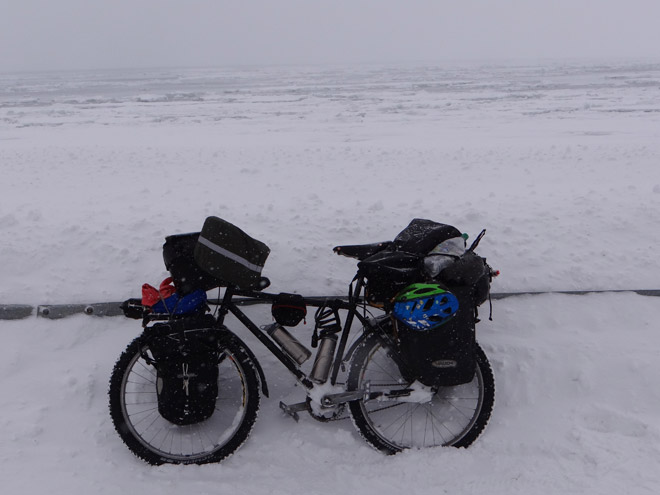
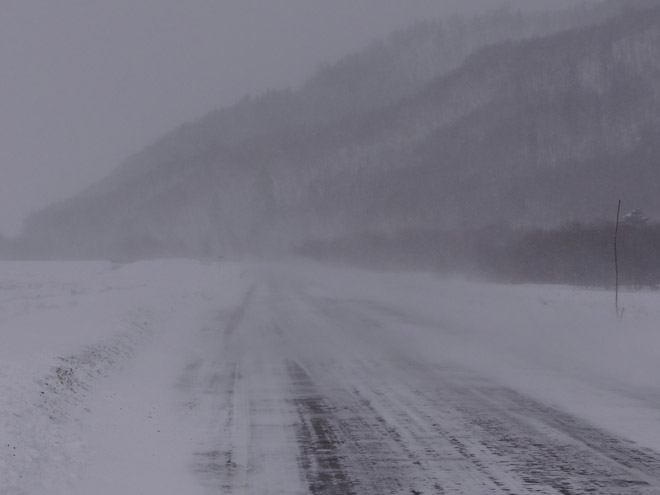
Beaten down by violent headwinds. Wish I was travelling in that direction.
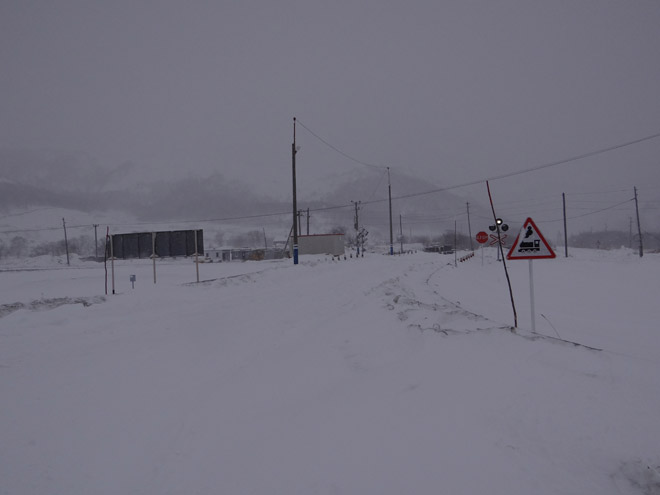
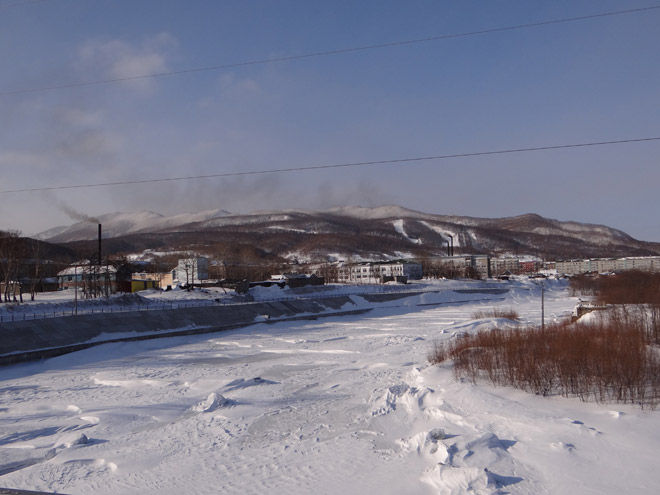
The bad conditions finally subsided and revealed a rugged, gleaming white coast line. Out to the east, broken slabs of ice float motionless in the ocean. There’s no animal life to be heard and virtually no traffic.
My feet continue giving me trouble, feeling wooden and numb. One morning I could hear excavators nearby so I hurried to break camp and headed straight for the excavation site, to refuel and assess the damage to my feet. Inside the grotty mess shed, I sat by the coal fire and removed my boots gingerly, relieved to fine my toes still pink and fleshy. A group of off-duty workers were playing cards and invited me to hang around for lunch.
On the road there’s been no hesitation towards kindness. One bloke pulled over in a black, jacked up Hilux. He was bearded and had a warm demeanour. Looking over my bike, he shook his head with a gigantic smile revealing gleaming gold teeth. He invited me to his place but I was reluctant to backtrack so I declined. Before driving away he untied a sack of fish in the tray of his truck and filled a supermarket bag full. It would have fed me for a month, but with limited space I could only accept a handful.
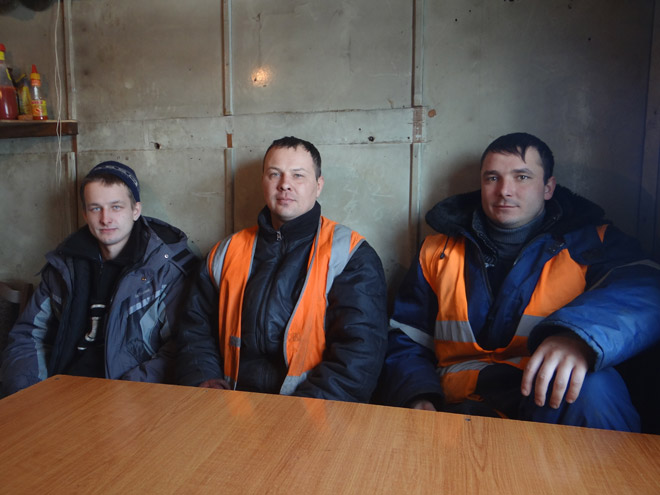
Some of the friendly guys at the excavation site. I dived into the mess shed, planted myself by the fire, removed my boots to inspect my feet, then introduced myself.
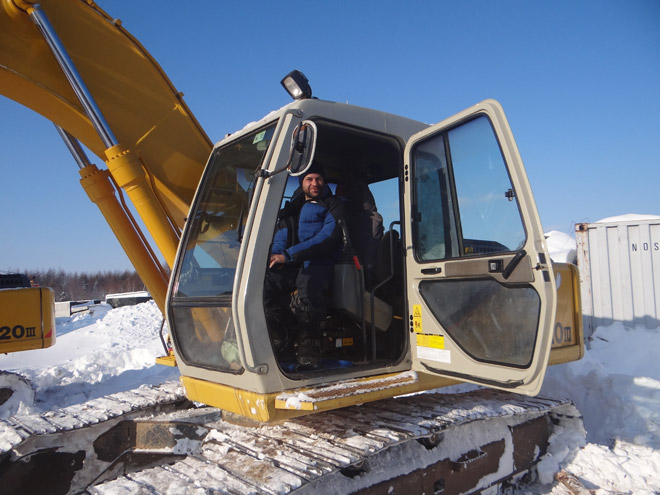
I was invited to climb into an excavator for a photo op. Didn’t get to turn it on unfortunately.
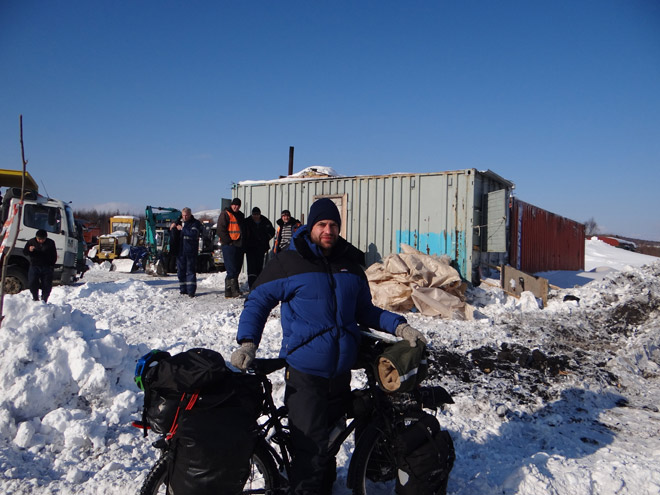
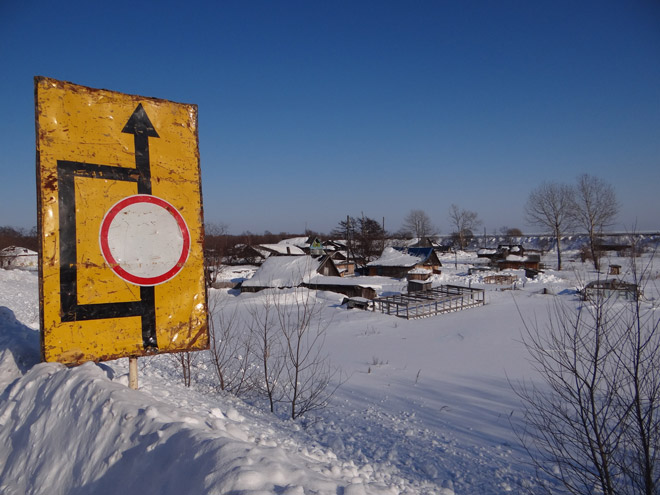
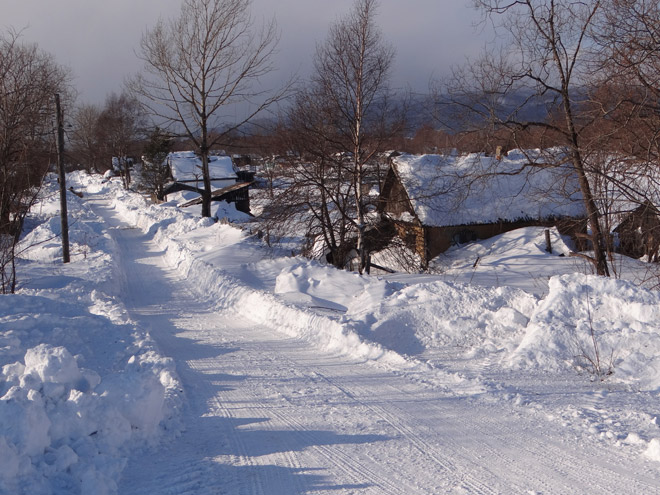
Cycled through some gorgeous villages built almost entirely out of timbre.
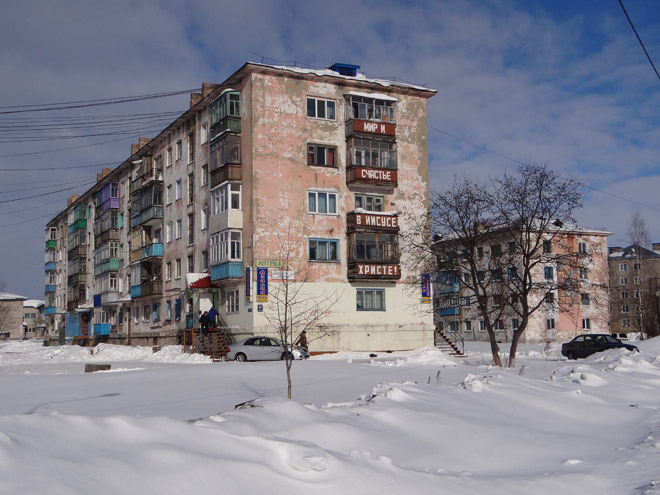
The drab concrete apartment blocks of city housing aren’t quite so endearing.
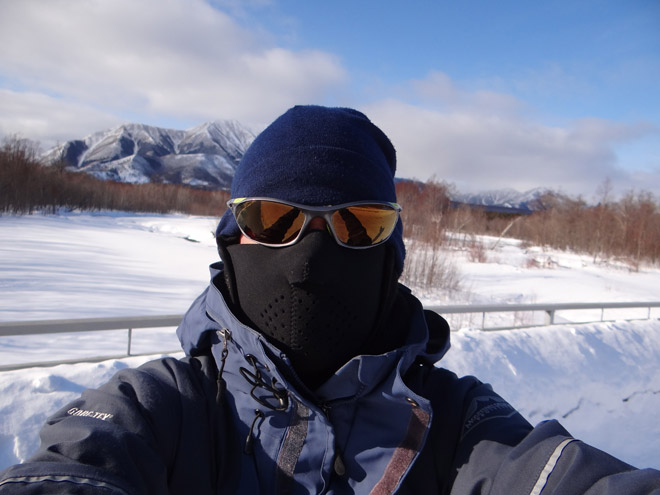
Even on sunny days the air temperature can be so frigid I need to cover up completely.
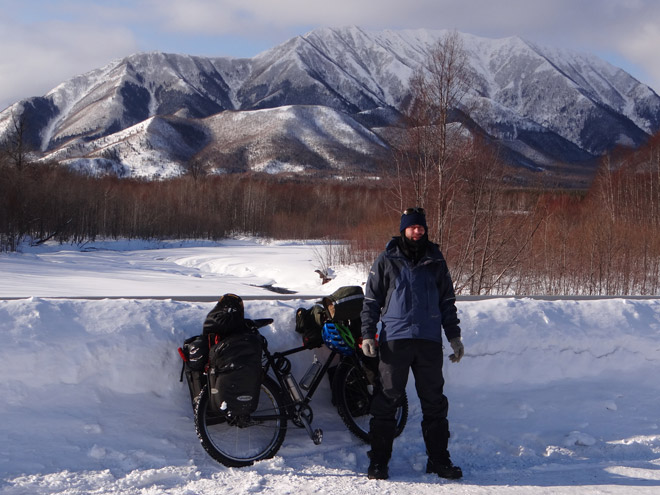
I am now travelling inland. That story coming up…


 Earth Odyssey Expedition
Leave a comment